> ## Documentation Index
> Fetch the complete documentation index at: https://langwatch.ai/docs/llms.txt
> Use this file to discover all available pages before exploring further.
# Introduction to Agent Testing
**Quick setup?** [Copy the scenarios prompt](/docs/skills/code-prompts#add-scenario-tests) into your coding agent to add simulation tests automatically.
# What are Agent Simulations?
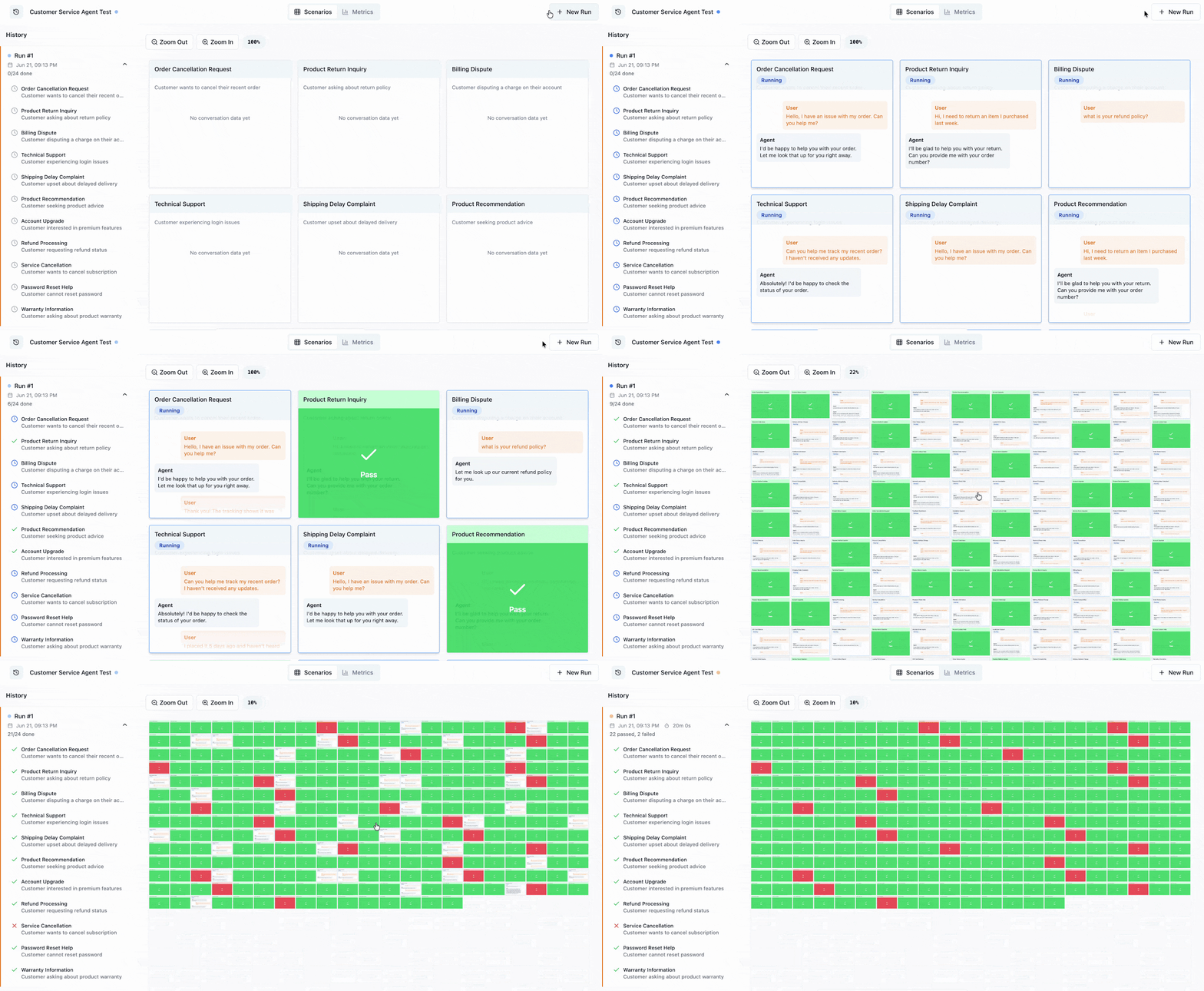
Agent simulations are a powerful approach to testing AI agents that goes beyond traditional evaluation methods. Unlike static input-output testing, simulations test your agent's behavior in realistic, multi-turn conversations that mimic how real users would interact with your system.
Powered by the open-source **[Scenario](https://github.com/langwatch/scenario)** framework — the same `scenario.run()` entrypoint and judge work across text, voice, and adversarial testing.
 ## What you can test
Simulate real users across multi-turn conversations and judge behavior at any step — tool calls, recovery, and end-to-end outcomes.
Test over real audio through ElevenLabs, OpenAI Realtime, Twilio, Pipecat and more — with background noise, interruptions, and latency metrics.
Run multi-turn adversarial attacks (Crescendo escalation, refusal detection, backtracking) to find security gaps before attackers do.
## The Three Levels of Agent Quality
For comprehensive agent testing, you need all three levels:
* **Level 1: Unit tests**\
Traditional unit and integration software tests to guarantee that e.g. the agent tools are working correctly from a software point of view
* **Level 2: Evals, Finetuning and Prompt Optimization**\
Measuring the performance of individual non-deterministic components of the agent, for example maximizing RAG accuracy with evals, or approximating human preference with GRPO
* **Level 3: Agent Simulations**\
End-to-end testing of the agent in different scenarios and edge cases, guaranteeing the whole agent achieves more than the sum of its parts, simulating a wide range of situations
Simulations complement evaluations by testing the **agent as a whole system** rather than isolated parts.
## Why Traditional Evaluation Isn't Enough for Agents
Most evaluations are based on dataset, with a static set of cases, those are hard to get specially when you are just getting started, they often require a great amount of examples to be valuable, and an expected answer to be provided, but more than anything, they are static, like input to output, or query to expected\_contexts.
Agents, however, aren't simple input-output functions. They are processes. An agent behaves like a program, executing a sequence of operations, using tools, and maintaining state.
### Evaluation dataset (single input-output pairs):
| query | expected\_answer |
| -------------------------------- | ------------------------------------------------------------------------------------------------------------ |
| What is your refund policy? | We offer a 30-day money-back guarantee on all purchases. |
| How do I cancel my subscription? | You can cancel your subscription by logging into your account and clicking the "Cancel Subscription" button. |
❌ Doesn't consider the conversational flow\
❌ Can't specify how middle steps should be evaluated\
❌ Hard to interpret and debug\
❌ Ignores user experience aspects\
❌ Hard to come up with a good dataset
### Agent simulation (full multi-turn descriptions):
```python theme={null}
script=[
scenario.user("hey I have a problem with my order"),
scenario.agent(),
expect_ticket_created()
expect_ticket_label("ecommerce")
scenario.user("i want a refund!"),
scenario.agent()
expect_tool_call("search_policy")
scenario.user("this is ridiculous! let me talk to a human being")
scenario.agent()
expect_tool_call("escalate_to_human")
]
```
✅ Describes the entire conversation\
✅ Explicitly evaluates in-between steps\
✅ Easy to interpret and debug\
✅ Easy to replicate and reproduce an issue found in production\
✅ Can run in autopilot for simulating a variety of inputs
**This doesn't mean you should stop doing evaluations**, in fact, having evaluations and simulations together is what composes your full agent test suite:
* Use evaluations for testing the smaller parts that compose the agent, where a more "machine learning" approach is required, for optimizing a specific LLM call or retrieval for example.
* Use simulation-based testing for proving the agent's behavior is correct end-to-end, replicate specific edge cases, and guide your agent's development without regressions.
## Why Use LangWatch Scenario?
[Scenario](https://langwatch.ai/scenario/) is the most advanced agent testing framework available. It provides:
* **Powerful simulations** - Test real agent behavior by simulating users in different scenarios and edge cases
* **Flexible evaluations** - Judge agent behavior at any point in conversations, combine with evals, test error recovery, and complex workflows
* **Voice testing** - Test voice agents end-to-end over real audio (ElevenLabs, OpenAI Realtime, Twilio, Pipecat) — [see Voice Agents](/docs/agent-simulations/voice-agents)
* **Red teaming** - Run multi-turn adversarial attacks to uncover security vulnerabilities — [see Red Teaming](/docs/agent-simulations/red-teaming)
* **Framework agnostic** - Works with any AI agent framework
* **Simple integration** - Just implement one `call()` method
* **Multi-language support** - Python, TypeScript, and Go
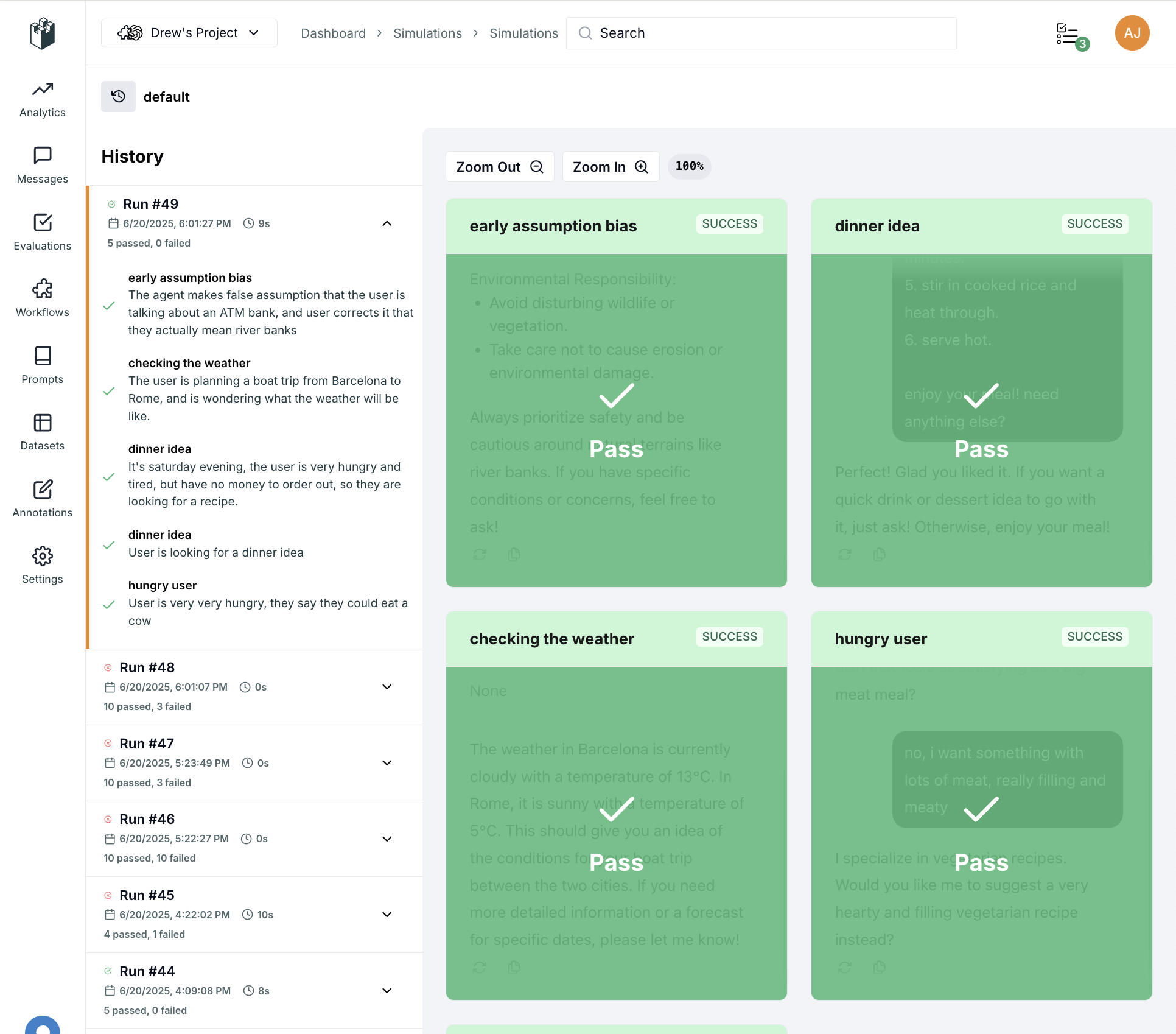
## Visualizing Simulations in LangWatch
Once you've set up your agent tests with Scenario, LangWatch provides powerful visualization tools to:
* **Organize simulations** into sets and batches
* **Debug agent behavior** by stepping through conversations
* **Track performance** over time with run history
* **Collaborate** with your team on agent improvements
See [the LangWatch Simulations visualizer](https://langwatch.ai/scenario/visualizations) to learn how to inspect, replay, and compare your runs.
## What you can test
Simulate real users across multi-turn conversations and judge behavior at any step — tool calls, recovery, and end-to-end outcomes.
Test over real audio through ElevenLabs, OpenAI Realtime, Twilio, Pipecat and more — with background noise, interruptions, and latency metrics.
Run multi-turn adversarial attacks (Crescendo escalation, refusal detection, backtracking) to find security gaps before attackers do.
## The Three Levels of Agent Quality
For comprehensive agent testing, you need all three levels:
* **Level 1: Unit tests**\
Traditional unit and integration software tests to guarantee that e.g. the agent tools are working correctly from a software point of view
* **Level 2: Evals, Finetuning and Prompt Optimization**\
Measuring the performance of individual non-deterministic components of the agent, for example maximizing RAG accuracy with evals, or approximating human preference with GRPO
* **Level 3: Agent Simulations**\
End-to-end testing of the agent in different scenarios and edge cases, guaranteeing the whole agent achieves more than the sum of its parts, simulating a wide range of situations
Simulations complement evaluations by testing the **agent as a whole system** rather than isolated parts.
## Why Traditional Evaluation Isn't Enough for Agents
Most evaluations are based on dataset, with a static set of cases, those are hard to get specially when you are just getting started, they often require a great amount of examples to be valuable, and an expected answer to be provided, but more than anything, they are static, like input to output, or query to expected\_contexts.
Agents, however, aren't simple input-output functions. They are processes. An agent behaves like a program, executing a sequence of operations, using tools, and maintaining state.
### Evaluation dataset (single input-output pairs):
| query | expected\_answer |
| -------------------------------- | ------------------------------------------------------------------------------------------------------------ |
| What is your refund policy? | We offer a 30-day money-back guarantee on all purchases. |
| How do I cancel my subscription? | You can cancel your subscription by logging into your account and clicking the "Cancel Subscription" button. |
❌ Doesn't consider the conversational flow\
❌ Can't specify how middle steps should be evaluated\
❌ Hard to interpret and debug\
❌ Ignores user experience aspects\
❌ Hard to come up with a good dataset
### Agent simulation (full multi-turn descriptions):
```python theme={null}
script=[
scenario.user("hey I have a problem with my order"),
scenario.agent(),
expect_ticket_created()
expect_ticket_label("ecommerce")
scenario.user("i want a refund!"),
scenario.agent()
expect_tool_call("search_policy")
scenario.user("this is ridiculous! let me talk to a human being")
scenario.agent()
expect_tool_call("escalate_to_human")
]
```
✅ Describes the entire conversation\
✅ Explicitly evaluates in-between steps\
✅ Easy to interpret and debug\
✅ Easy to replicate and reproduce an issue found in production\
✅ Can run in autopilot for simulating a variety of inputs
**This doesn't mean you should stop doing evaluations**, in fact, having evaluations and simulations together is what composes your full agent test suite:
* Use evaluations for testing the smaller parts that compose the agent, where a more "machine learning" approach is required, for optimizing a specific LLM call or retrieval for example.
* Use simulation-based testing for proving the agent's behavior is correct end-to-end, replicate specific edge cases, and guide your agent's development without regressions.
## Why Use LangWatch Scenario?
[Scenario](https://langwatch.ai/scenario/) is the most advanced agent testing framework available. It provides:
* **Powerful simulations** - Test real agent behavior by simulating users in different scenarios and edge cases
* **Flexible evaluations** - Judge agent behavior at any point in conversations, combine with evals, test error recovery, and complex workflows
* **Voice testing** - Test voice agents end-to-end over real audio (ElevenLabs, OpenAI Realtime, Twilio, Pipecat) — [see Voice Agents](/docs/agent-simulations/voice-agents)
* **Red teaming** - Run multi-turn adversarial attacks to uncover security vulnerabilities — [see Red Teaming](/docs/agent-simulations/red-teaming)
* **Framework agnostic** - Works with any AI agent framework
* **Simple integration** - Just implement one `call()` method
* **Multi-language support** - Python, TypeScript, and Go
## Visualizing Simulations in LangWatch
Once you've set up your agent tests with Scenario, LangWatch provides powerful visualization tools to:
* **Organize simulations** into sets and batches
* **Debug agent behavior** by stepping through conversations
* **Track performance** over time with run history
* **Collaborate** with your team on agent improvements
See [the LangWatch Simulations visualizer](https://langwatch.ai/scenario/visualizations) to learn how to inspect, replay, and compare your runs.
 ## Next Steps
* [Getting Started](/docs/agent-simulations/getting-started) - Set up your first simulation
* [Voice Agents](/docs/agent-simulations/voice-agents) - Test voice agents end-to-end over real audio
* [Red Teaming](/docs/agent-simulations/red-teaming) - Run adversarial attacks against your agent
* [Scenario Documentation](https://langwatch.ai/scenario/) - Deep dive into the testing framework
## Next Steps
* [Getting Started](/docs/agent-simulations/getting-started) - Set up your first simulation
* [Voice Agents](/docs/agent-simulations/voice-agents) - Test voice agents end-to-end over real audio
* [Red Teaming](/docs/agent-simulations/red-teaming) - Run adversarial attacks against your agent
* [Scenario Documentation](https://langwatch.ai/scenario/) - Deep dive into the testing framework