> ## Documentation Index
> Fetch the complete documentation index at: https://langwatch.ai/docs/llms.txt
> Use this file to discover all available pages before exploring further.
# Ingestion Templates
> Connect Claude Code, Cursor, and other tool-specific telemetry to your personal LangWatch workspace with a write-only ingestion key, traces auto-shaped via platform-published OTTL transforms.
# Ingestion Templates
> **Status:** v1, push-mode templates only. OAuth-redirect and pull-mode (S3, API) shapes are reserved for a future iteration.
LangWatch's **Ingestion Templates** let you connect tool-specific telemetry sources
(Claude Code on Anthropic 20x, Cursor, Claude cowork, …) to your **personal workspace**
without LangWatch ever participating in the upstream tool's authentication.
You install a template, paste an **ingestion key** into your tool's OTLP exporter, and
traces land at `/me/traces` already shaped into the canonical `gen_ai.*` form, cost,
tokens, and model populated automatically. An ingestion key is just an
[API key](/docs/platform/api-keys) (`sk-lw-…`) scoped to one project with a write-only,
ingest-only role: it can create traces and nothing else, so it's safe to spray into an
agent's environment.
***
## Why ingestion templates exist
If your tool has a LangWatch virtual key, the AI Gateway proxies the request and we ingest
canonical traces from the gateway response. Done.
But many tools don't fit that path:
* **Subscription-bound tools**: Claude Code on Anthropic 20x, GitHub Copilot, etc. The user
has no API key the gateway can proxy through; the tool authenticates client-side with the
upstream provider.
* **Native-OTLP tools**: Cursor, Claude cowork, Continue.dev, Aider, Cline. They already
emit OpenTelemetry traces locally; what they need is a place to ship them.
For these, the user holds the upstream credential locally; LangWatch only needs to know
**where to send the OTLP** and **which template the trace references** so it gets the
right `langwatch.source` provenance and lands in the right personal project.
That's an Ingestion Template:
* **Admin/platform side:** a curated catalog row (slug, source identifier, credential
schema, optional `ottlRules`). Platform-published rows ship empty `ottlRules` —
Claude Code, Cursor, and Claude cowork all emit OpenTelemetry `gen_ai.*` canonical
spans natively, so no transform is needed for the common case. **Org admins can clone
a platform-default template into an org-authored template** and author OTTL via the
OttlEditor at `/settings/governance/tool-catalog → Ingestion Templates → Clone to
customise → Edit OTTL`, to adapt a template to their org's upstream-tool quirks (an
internal IDE wrapper, a custom Cursor build, etc). Platform rows are read-only —
admins click **Clone to customise** which calls
`ingestionTemplates.cloneFromPlatform`, then **Edit OTTL** on the new org-authored
row to refine the rules.
* **User side:** an ingestion key (`sk-lw-…`) scoped to your personal project with a
write-only, ingest-only role. You paste that key into your tool's OTLP exporter; the
tool ships, the receiver verifies the key, ceilings it to ingest-only, lands the trace
in the key's bound project, and applies the referenced template's OTTL (empty for
platform defaults, admin-authored for org forks) when the key carries a `templateId`.
Credential is scope. Payload is advisory. The receiver attribution path is identical to
gateway-VK ingest; the source-shape OTTL is org-customizable for admins who need it.
***
## Worked example: connect Claude Code on Anthropic 20x
This walks through the whole flow end-to-end. By the end you'll have a Claude Code
trace visible at `/me/traces` with `gen_ai.usage.*`, `gen_ai.response.model`, and
`langwatch.cost.usd` populated.
> **Before you start:** you need a LangWatch account. If you're brand new, start with the
> [getting started guide](/docs/ai-governance/getting-started-developer) and then sign in to
> LangWatch. First-time sign-in completes onboarding and lands you on your **personal
> workspace** (`/me`). On self-hosted instances the same path works against your own
> deployment's host.
### Step 1: open the catalog
Navigate to `/me` and scroll to the **Trace Ingest** section (or jump straight to
`/me#trace-ingest`).
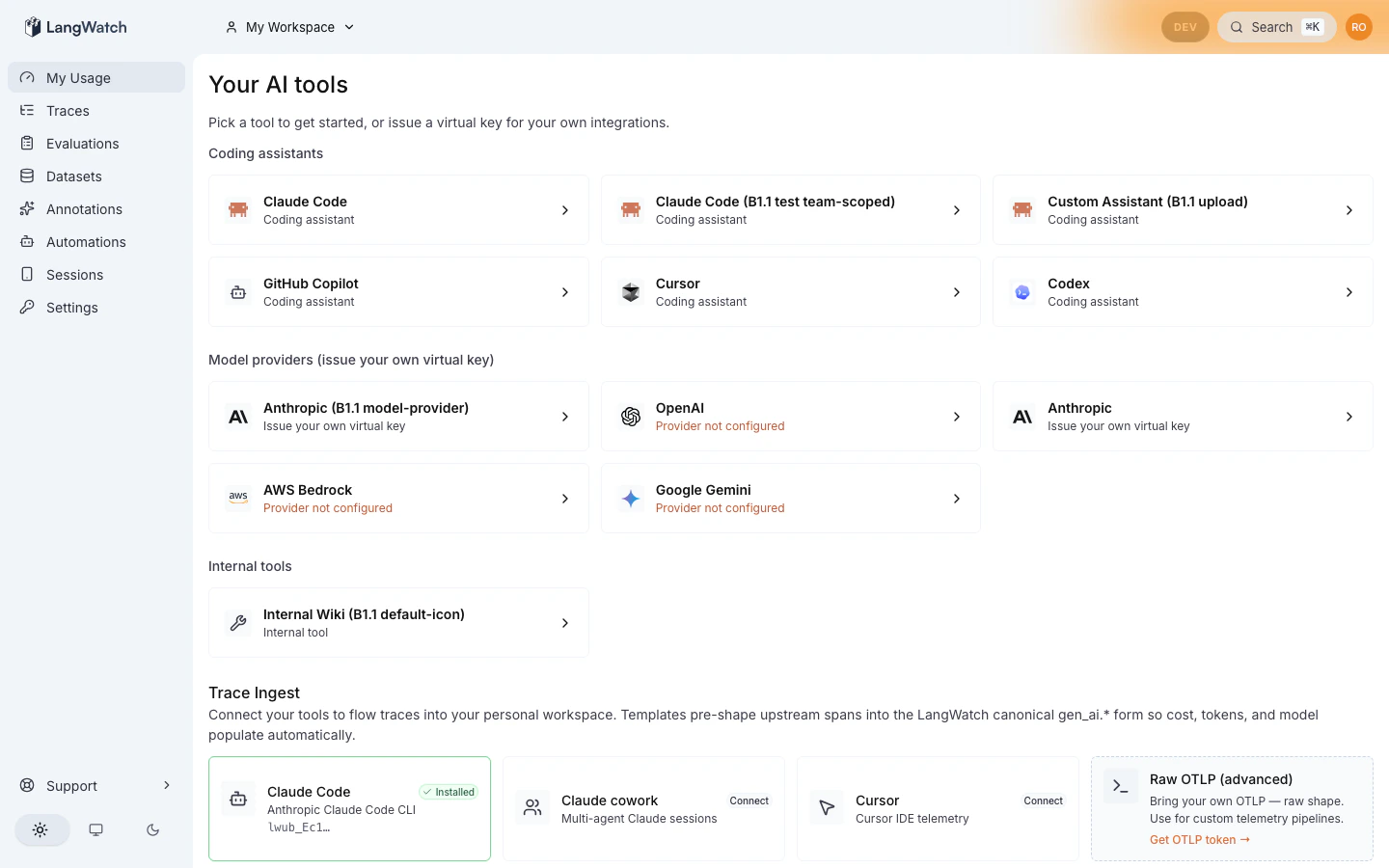 You'll see four tiles: **Claude Code**, **Cursor**, **Claude cowork**, and the
**Raw OTLP (advanced)** discovery card. The first three are tool-specific templates; the
fourth is for ad-hoc/custom telemetry.
### Step 2: install the Claude Code template
Click **Install** on the Claude Code tile. A drawer slides in headed
**Connect Claude Code, auto-shaped**, with the subcopy *"Traces normalized into
gen\_ai.\* canonical. Cost/tokens/model populated automatically by the receiver."*
You'll see four tiles: **Claude Code**, **Cursor**, **Claude cowork**, and the
**Raw OTLP (advanced)** discovery card. The first three are tool-specific templates; the
fourth is for ad-hoc/custom telemetry.
### Step 2: install the Claude Code template
Click **Install** on the Claude Code tile. A drawer slides in headed
**Connect Claude Code, auto-shaped**, with the subcopy *"Traces normalized into
gen\_ai.\* canonical. Cost/tokens/model populated automatically by the receiver."*
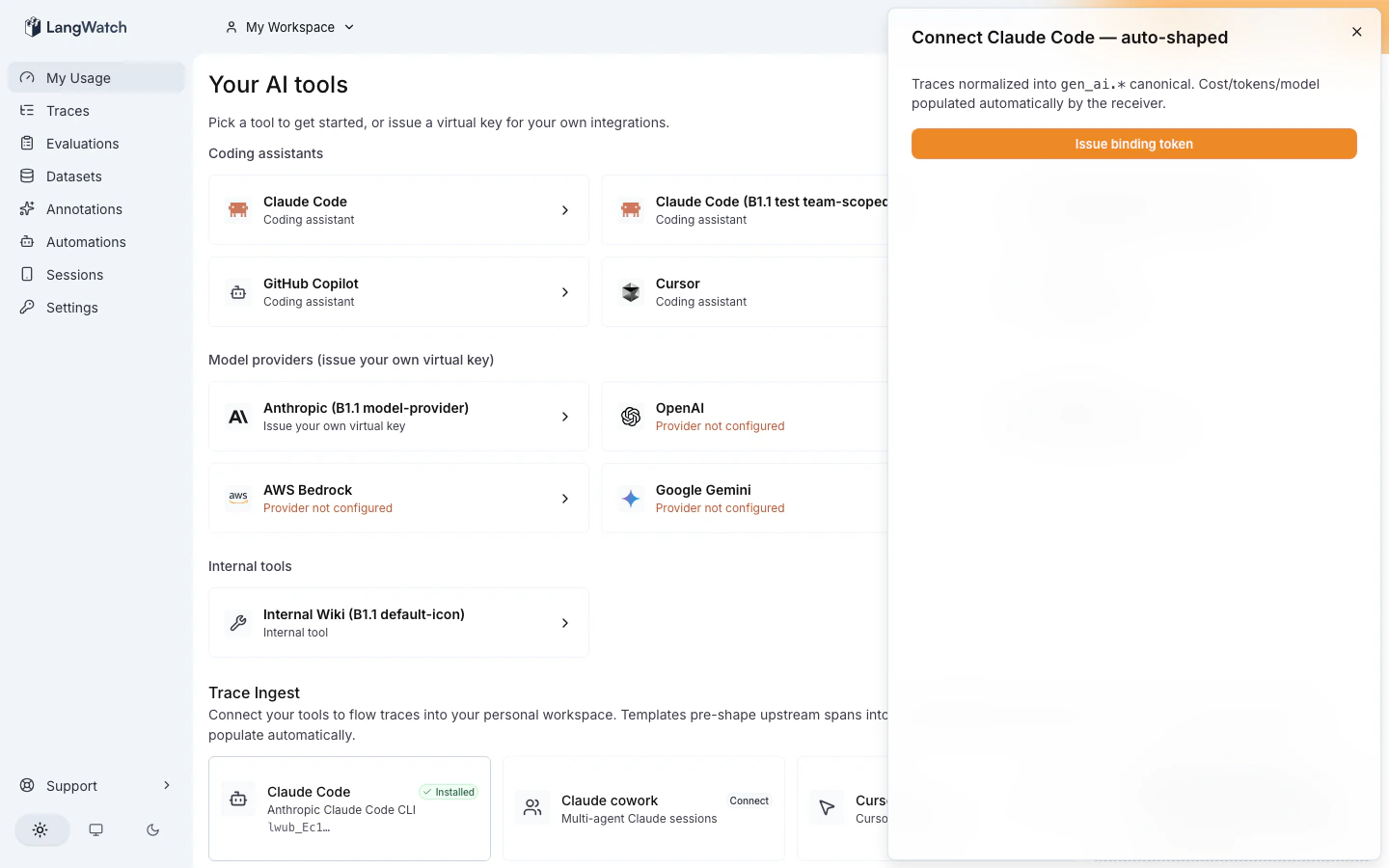 The drawer shows:
* **OTLP endpoint**: read-only, copyable.
* **Ingestion key**: `sk-lw-…` issued one-time, with a Show/Hide toggle. Copy it
while it's visible; after you dismiss the drawer it's masked to its first
characters.
* **Snippet preview**: pre-wired environment variables for Claude Code:
```bash theme={null}
export OTEL_EXPORTER_OTLP_ENDPOINT="https://app.langwatch.ai/api/otel"
export OTEL_EXPORTER_OTLP_HEADERS="Authorization=Bearer sk-lw-"
```
(Self-hosted: replace the host with your LangWatch base URL. The drawer always
shows the correct endpoint for your instance.)
Copy the snippet, then click **Mark installed**. The tile flips to a green-checked state
with a **View traces →** deep-link.
The key is shown one-time. If you lose it, **rotate** the ingestion key from the tile to
mint a new one. The previous key is revoked immediately when you rotate (hard-cut v1).
### Step 3: fire your first Claude Code action
Open a new terminal so the env vars take effect, then run Claude Code as you normally
would. As soon as Claude Code completes its first action, OpenTelemetry exports the span
to your LangWatch personal workspace.
### Step 4: see the trace at /me/traces
Click **View traces →** on the tile, or navigate directly to `/me/traces`.
The drawer shows:
* **OTLP endpoint**: read-only, copyable.
* **Ingestion key**: `sk-lw-…` issued one-time, with a Show/Hide toggle. Copy it
while it's visible; after you dismiss the drawer it's masked to its first
characters.
* **Snippet preview**: pre-wired environment variables for Claude Code:
```bash theme={null}
export OTEL_EXPORTER_OTLP_ENDPOINT="https://app.langwatch.ai/api/otel"
export OTEL_EXPORTER_OTLP_HEADERS="Authorization=Bearer sk-lw-"
```
(Self-hosted: replace the host with your LangWatch base URL. The drawer always
shows the correct endpoint for your instance.)
Copy the snippet, then click **Mark installed**. The tile flips to a green-checked state
with a **View traces →** deep-link.
The key is shown one-time. If you lose it, **rotate** the ingestion key from the tile to
mint a new one. The previous key is revoked immediately when you rotate (hard-cut v1).
### Step 3: fire your first Claude Code action
Open a new terminal so the env vars take effect, then run Claude Code as you normally
would. As soon as Claude Code completes its first action, OpenTelemetry exports the span
to your LangWatch personal workspace.
### Step 4: see the trace at /me/traces
Click **View traces →** on the tile, or navigate directly to `/me/traces`.
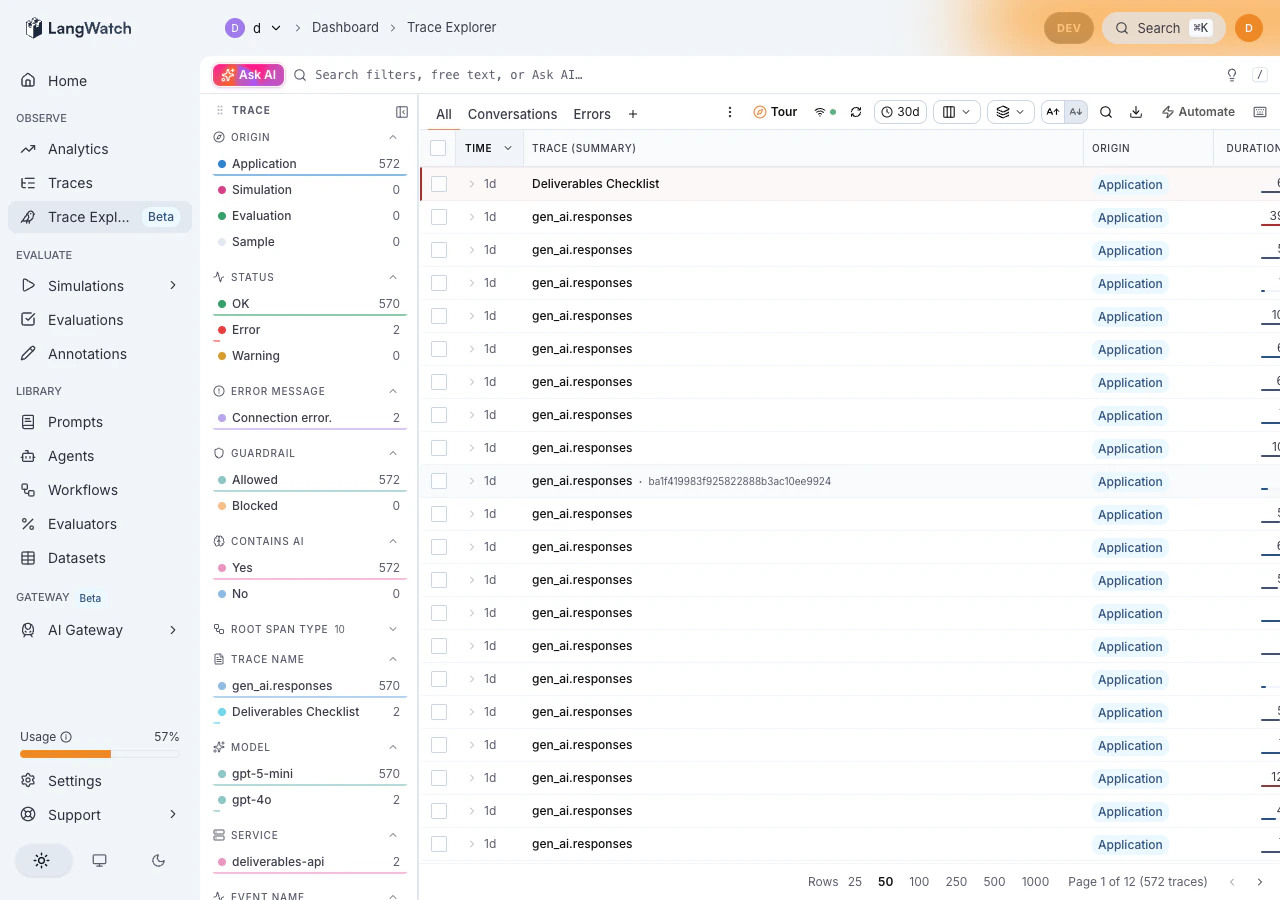 Open the trace. You should see:
* `gen_ai.system = "anthropic"`
* `gen_ai.request.model = "claude-3-5-sonnet"` (or whichever model you ran)
* `gen_ai.usage.input_tokens`, emitted directly by Claude Code's OTel exporter
(Claude Code is gen\_ai-canonical natively; v1 templates apply no OTTL transform).
* `gen_ai.usage.output_tokens`, same.
* `langwatch.cost.usd`, derived by the receiver's `canonicalCostExtractor` from the
upstream-emitted `gen_ai.usage.*` + `gen_ai.response.model`.
* `langwatch.user.id`, `langwatch.project.id`, `langwatch.template.id`,
`langwatch.api_key.id`, `langwatch.source = "claude_code"`, all receiver-stamped
post-auth (authoritative attribution + template provenance), with
`langwatch.origin = "coding_agent"` (derived from the source: a CLI coding
assistant becomes `coding_agent`, any other ingest source becomes `ai_tool`).
That's it. From here, every Claude Code action you run flows into your personal workspace
shaped correctly, same as if you'd been running through the gateway VK path.
***
## Under the hood
This section is for engineering leads, security reviewers who want to understand the
trust model and the request flow. End users can skip ahead to [Raw OTLP fallback](#raw-otlp-fallback).
### Anatomy of an Ingestion Template
An `IngestionTemplate` row has:
* `slug` (e.g. `claude_code`), referenced by an ingestion key via its `templateId`.
* `sourceType` (e.g. `claude_code`), which upstream tool this template parses.
* `credentialSchema` (closed enum, v1: `null`, `static_api_key`, `agent_id`), what
fields the install drawer captures from the user.
* `ottlRules`, an optional OTTL transform applied to the span before the receiver's
authoritative re-stamp pass. **Platform-default templates ship empty `ottlRules`**
because Claude Code, Cursor, and Claude cowork all emit OpenTelemetry `gen_ai.*`
canonical spans natively, there is nothing to reshape for the common case. **Org
admins can fork a platform-default template into an org-authored template and author
OTTL via the OttlEditor** in `/settings/governance/tool-catalog → Ingestion
Templates → Edit OTTL`. Forking lets the admin adapt a template to their org's
upstream-tool quirks (an internal IDE wrapper, a custom Cursor build, a corporate
Claude Code variant) without filing a request for a platform change.
* `organizationId`, `NULL` for platform-published templates (visible everywhere); set
for org-authored templates (visible only to that org). Forks created via "Edit OTTL"
land here.
### credentialSchema shapes
| schema | what the install drawer captures | covers v1 |
| ---------------- | -------------------------------------------- | --------------------------------------------------------- |
| `null` | nothing, drawer auto-mints the ingestion key | claude\_code, cursor, claude\_cowork, raw\_otlp\_advanced |
| `static_api_key` | one labeled API key field | (deferred to v1.1+) |
| `agent_id` | a labeled agent-identifier text input | (deferred to v1.1+) |
`oauth_redirect` and `s3_bucket` are reserved for a future iteration, those require
upstream OAuth refresh, polling, watermark infrastructure that isn't in the v1 push-only
shape.
### Receiver resolution flow
When your tool emits an OTLP payload with `Authorization: Bearer sk-lw-`, the
receiver:
1. **Prefix-discriminates** the bearer, `sk-lw-*` → ApiKey verification path.
2. **Verifies** the key (HMAC + pepper) and resolves the `ApiKey` row, the same path
any SDK or management key takes.
3. **Ceilings to ingest-only.** An ingestion key carries a write-only, ingest-only role
that grants `traces:create` and nothing else, so the receiver rejects any non-ingest
operation regardless of what the payload claims.
4. **Sets `tenantId`** to the key's bound project, credential-as-scope. This is
authoritative.
5. **Applies `template.ottlRules`** under a snapshot+restore principal-field guard, but
only when the ingestion key carries a `templateId`. For platform-default templates
the rules are empty so this step is a no-op; for org-authored forks the admin's OTTL
runs here under the protection lists below. A key with no `templateId` skips OTTL
entirely and lands raw.
6. **Post-auth re-stamps** the closed `protectedTemplateAttributeKeys` (and, for
org-authored OTTL, the tier-of-trust additions covering cost, tokens, model) as
receiver-authoritative, including `langwatch.api_key.id` and
`langwatch.origin` provenance (derived from the key's source: `coding_agent`
for a CLI assistant, `ai_tool` otherwise). If the OTTL tried to write any of those
keys, the original value is restored and an audit row
`gateway.template_ottl_protected_field_attempt` fires with the rejected-key list.
7. **Hands off** to the trace pipeline, same path as every other ingest source from
here.
The ingest-only ceiling at step 3 and the principal-field guard at step 6 are the
load-bearing security primitives.
### What the principal-field guard protects
The `protectedTemplateAttributeKeys` closed list:
* The `protectedAttributeKeys` from the base OTTL guard (B6), all attribution
shapes: `langwatch.user.id`, `langwatch.team.id`, `langwatch.organization.id`,
`langwatch.project.id`, `langwatch.tenant.id`, virtual-key shapes,
ingestion-source shapes, governance shapes.
* `langwatch.template.id`, receiver-stamped provenance.
* `langwatch.api_key.id`, receiver-stamped provenance (the ingestion key that landed
the trace).
* `langwatch.origin`, receiver-stamped provenance (`coding_agent` for a CLI
assistant, `ai_tool` for any other ingest source).
* `langwatch.source`, receiver-stamped provenance (used for tile filtering at
`/me/traces`).
Notably **not** in the list:
* `langwatch.cost.usd`, `.input`, `.output`
* `gen_ai.usage.input_tokens`, `.output_tokens`, `.total_tokens`
* `gen_ai.response.model`
For **platform-default templates** these stay receiver-derived (cost via
`canonicalCostExtractor` reading upstream-emitted `gen_ai.usage.*`). Platform-default
templates ship empty `ottlRules`, so the protected list is dormant on this path.
For **org-authored templates** (forks created via the OttlEditor) the receiver
applies a **tier-of-trust** addition: the org-authored OTTL is allowed to reshape
upstream-specific attrs into the canonical keys (that's the template's whole job),
but `langwatch.cost.usd*`, `gen_ai.usage.*`, and `gen_ai.response.model` are pinned
to receiver-authoritative values via `canonicalCostExtractor` to prevent within-org
cost-attribution forgery.
See [Security model recap](#security-model-recap) below for the per-tier trust
boundary articulation.
***
## Raw OTLP fallback
If you have a custom telemetry pipeline, your own spans, your own normalisation, your
own cost calculations, you don't want a template's OTTL rewriting your shape. Use the
**Raw OTLP (advanced)** card on `/me` Trace Ingest instead.
The card deep-links to the **Personal OTLP Endpoint** panel at `/me/settings#otlp`,
which surfaces your personal-project's existing OTLP endpoint and API key for ad-hoc /
custom telemetry. No template OTTL is applied; your spans land at `/me/traces` exactly
as you emit them.
Open the trace. You should see:
* `gen_ai.system = "anthropic"`
* `gen_ai.request.model = "claude-3-5-sonnet"` (or whichever model you ran)
* `gen_ai.usage.input_tokens`, emitted directly by Claude Code's OTel exporter
(Claude Code is gen\_ai-canonical natively; v1 templates apply no OTTL transform).
* `gen_ai.usage.output_tokens`, same.
* `langwatch.cost.usd`, derived by the receiver's `canonicalCostExtractor` from the
upstream-emitted `gen_ai.usage.*` + `gen_ai.response.model`.
* `langwatch.user.id`, `langwatch.project.id`, `langwatch.template.id`,
`langwatch.api_key.id`, `langwatch.source = "claude_code"`, all receiver-stamped
post-auth (authoritative attribution + template provenance), with
`langwatch.origin = "coding_agent"` (derived from the source: a CLI coding
assistant becomes `coding_agent`, any other ingest source becomes `ai_tool`).
That's it. From here, every Claude Code action you run flows into your personal workspace
shaped correctly, same as if you'd been running through the gateway VK path.
***
## Under the hood
This section is for engineering leads, security reviewers who want to understand the
trust model and the request flow. End users can skip ahead to [Raw OTLP fallback](#raw-otlp-fallback).
### Anatomy of an Ingestion Template
An `IngestionTemplate` row has:
* `slug` (e.g. `claude_code`), referenced by an ingestion key via its `templateId`.
* `sourceType` (e.g. `claude_code`), which upstream tool this template parses.
* `credentialSchema` (closed enum, v1: `null`, `static_api_key`, `agent_id`), what
fields the install drawer captures from the user.
* `ottlRules`, an optional OTTL transform applied to the span before the receiver's
authoritative re-stamp pass. **Platform-default templates ship empty `ottlRules`**
because Claude Code, Cursor, and Claude cowork all emit OpenTelemetry `gen_ai.*`
canonical spans natively, there is nothing to reshape for the common case. **Org
admins can fork a platform-default template into an org-authored template and author
OTTL via the OttlEditor** in `/settings/governance/tool-catalog → Ingestion
Templates → Edit OTTL`. Forking lets the admin adapt a template to their org's
upstream-tool quirks (an internal IDE wrapper, a custom Cursor build, a corporate
Claude Code variant) without filing a request for a platform change.
* `organizationId`, `NULL` for platform-published templates (visible everywhere); set
for org-authored templates (visible only to that org). Forks created via "Edit OTTL"
land here.
### credentialSchema shapes
| schema | what the install drawer captures | covers v1 |
| ---------------- | -------------------------------------------- | --------------------------------------------------------- |
| `null` | nothing, drawer auto-mints the ingestion key | claude\_code, cursor, claude\_cowork, raw\_otlp\_advanced |
| `static_api_key` | one labeled API key field | (deferred to v1.1+) |
| `agent_id` | a labeled agent-identifier text input | (deferred to v1.1+) |
`oauth_redirect` and `s3_bucket` are reserved for a future iteration, those require
upstream OAuth refresh, polling, watermark infrastructure that isn't in the v1 push-only
shape.
### Receiver resolution flow
When your tool emits an OTLP payload with `Authorization: Bearer sk-lw-`, the
receiver:
1. **Prefix-discriminates** the bearer, `sk-lw-*` → ApiKey verification path.
2. **Verifies** the key (HMAC + pepper) and resolves the `ApiKey` row, the same path
any SDK or management key takes.
3. **Ceilings to ingest-only.** An ingestion key carries a write-only, ingest-only role
that grants `traces:create` and nothing else, so the receiver rejects any non-ingest
operation regardless of what the payload claims.
4. **Sets `tenantId`** to the key's bound project, credential-as-scope. This is
authoritative.
5. **Applies `template.ottlRules`** under a snapshot+restore principal-field guard, but
only when the ingestion key carries a `templateId`. For platform-default templates
the rules are empty so this step is a no-op; for org-authored forks the admin's OTTL
runs here under the protection lists below. A key with no `templateId` skips OTTL
entirely and lands raw.
6. **Post-auth re-stamps** the closed `protectedTemplateAttributeKeys` (and, for
org-authored OTTL, the tier-of-trust additions covering cost, tokens, model) as
receiver-authoritative, including `langwatch.api_key.id` and
`langwatch.origin` provenance (derived from the key's source: `coding_agent`
for a CLI assistant, `ai_tool` otherwise). If the OTTL tried to write any of those
keys, the original value is restored and an audit row
`gateway.template_ottl_protected_field_attempt` fires with the rejected-key list.
7. **Hands off** to the trace pipeline, same path as every other ingest source from
here.
The ingest-only ceiling at step 3 and the principal-field guard at step 6 are the
load-bearing security primitives.
### What the principal-field guard protects
The `protectedTemplateAttributeKeys` closed list:
* The `protectedAttributeKeys` from the base OTTL guard (B6), all attribution
shapes: `langwatch.user.id`, `langwatch.team.id`, `langwatch.organization.id`,
`langwatch.project.id`, `langwatch.tenant.id`, virtual-key shapes,
ingestion-source shapes, governance shapes.
* `langwatch.template.id`, receiver-stamped provenance.
* `langwatch.api_key.id`, receiver-stamped provenance (the ingestion key that landed
the trace).
* `langwatch.origin`, receiver-stamped provenance (`coding_agent` for a CLI
assistant, `ai_tool` for any other ingest source).
* `langwatch.source`, receiver-stamped provenance (used for tile filtering at
`/me/traces`).
Notably **not** in the list:
* `langwatch.cost.usd`, `.input`, `.output`
* `gen_ai.usage.input_tokens`, `.output_tokens`, `.total_tokens`
* `gen_ai.response.model`
For **platform-default templates** these stay receiver-derived (cost via
`canonicalCostExtractor` reading upstream-emitted `gen_ai.usage.*`). Platform-default
templates ship empty `ottlRules`, so the protected list is dormant on this path.
For **org-authored templates** (forks created via the OttlEditor) the receiver
applies a **tier-of-trust** addition: the org-authored OTTL is allowed to reshape
upstream-specific attrs into the canonical keys (that's the template's whole job),
but `langwatch.cost.usd*`, `gen_ai.usage.*`, and `gen_ai.response.model` are pinned
to receiver-authoritative values via `canonicalCostExtractor` to prevent within-org
cost-attribution forgery.
See [Security model recap](#security-model-recap) below for the per-tier trust
boundary articulation.
***
## Raw OTLP fallback
If you have a custom telemetry pipeline, your own spans, your own normalisation, your
own cost calculations, you don't want a template's OTTL rewriting your shape. Use the
**Raw OTLP (advanced)** card on `/me` Trace Ingest instead.
The card deep-links to the **Personal OTLP Endpoint** panel at `/me/settings#otlp`,
which surfaces your personal-project's existing OTLP endpoint and API key for ad-hoc /
custom telemetry. No template OTTL is applied; your spans land at `/me/traces` exactly
as you emit them.
 ### When to choose Raw OTLP vs a template
| You should pick | When |
| --------------------------------------- | --------------------------------------------------------------------------------------------------------------------------- |
| Claude Code, Cursor, Claude cowork tile | You run that tool and want LangWatch's catalog OTTL to normalise the spans for you. |
| Raw OTLP (advanced) | You have a custom pipeline, or your spans already follow `gen_ai.*` conventions, or you want to keep your own field shapes. |
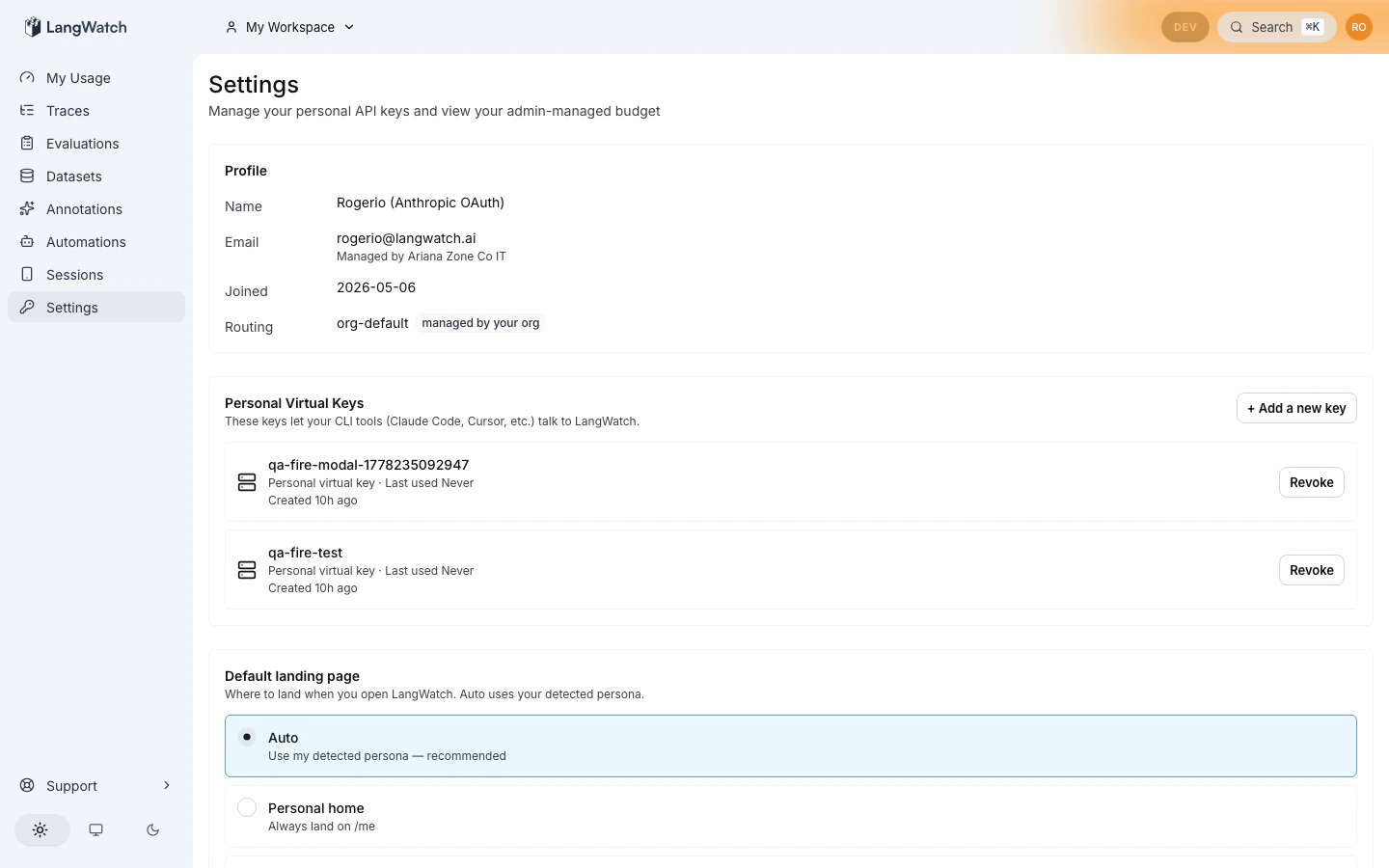
You can also surface the same endpoint + token from `/me/settings → Personal OTLP Endpoint`
without going through the catalog tile.
***
## Security model recap
For security reviewers evaluating the feature.
### Trust boundary
* **Credential = scope.** The `sk-lw-*` ingestion key authoritatively determines which
project a trace lands in, and its write-only ingest-only role caps it to
`traces:create`. Payload-level claims about user, team, org, project attribution are
advisory and re-stamped post-OTTL.
* **Cross-project guard at mint** is structural: the install drawer (and the
`langwatch ` CLI) mints the key against the user's resolved personal project;
the caller never picks the target project. Minting a key into someone else's project
is unrepresentable.
* **Cross-project guard at receive** is the ingest-only ceiling plus the post-OTTL
principal-field re-stamp. Forge attempts emit
`gateway.template_ottl_protected_field_attempt` audit rows.
### Trust boundary: two tiers
LangWatch v1 ships two distinct template tiers with different trust contracts:
**Tier 1, Platform-default templates** (`organizationId IS NULL`). Empty `ottlRules`.
Cost, tokens, model values come directly from the upstream tool's OTel exporter
(Claude Code, Cursor, and Claude cowork all emit `gen_ai.*` canonical natively), and the
receiver derives `langwatch.cost.usd` from those upstream-emitted values via
`canonicalCostExtractor`. Trust here rides on **upstream-tool correctness**: we trust
Claude Code, Cursor, and Claude cowork to populate `gen_ai.usage.*` correctly per the
OTel semantic-conventions spec.
**Tier 2, Org-authored templates** (`organizationId NOT NULL`, forked from a tier-1
template via the OttlEditor at `/settings/governance/tool-catalog → Ingestion
Templates → Edit OTTL`). Admins author OTTL to adapt a template to their org's
upstream-tool quirks. Trust here rides on **org-admin review at save time**: the
admin who clicks "Save & validate" is accepting within-org responsibility for the
transform's correctness. Three protection layers prevent admin OTTL from being
weaponized against the org or other orgs:
1. The `protectedTemplateAttributeKeys` guard at receive time (attribution +
provenance, admin OTTL cannot rewrite who/where/which-template a trace came from).
2. A tier-2 superset that adds `langwatch.cost.usd*`, `gen_ai.usage.*`, and
`gen_ai.response.model` to the protected set so admin OTTL cannot forge cost-
attribution within the org.
3. Static analysis at save time, the OttlEditor's "Save & validate" step rejects
OTTL that would write any protected key BEFORE the rules are persisted, with an
inline error pointing at the offending line.
Cross-org cost integrity is structurally protected on both tiers by the attribution-keys
re-stamp regardless of OTTL, admin OTTL in org-A cannot misattribute cost to org-B.
Concretely, before each tile flips to green-checked we run a **two-track dogfood
discipline**: (a) a fixture-track verification, canned OTLP payloads emitted via
`scripts/dogfood/emit-otlp.sh`, including forge-attempt regressions against both the
base and tier-2 protected lists, and (b) a real-user track, admin publishes via
`/settings/governance/tool-catalog`, a real user installs via `/me`, the real upstream
tool emits a real trace, and the result is verified end-to-end with cross-user isolation.
Per-template rituals live at `langwatch/ee/governance/ingestion-templates//dogfood.md`.
### What is audited
State-change rows only, per-trace activity is tracked via the ingestion key's
`lastUsedAt`, not via audit volume.
| Event | When fires |
| ----------------------------------------------- | ------------------------------------------------------------------------- |
| `gateway.ingestion_key.minted` | User installs a template (mints an ingestion key) via the catalog tile |
| `gateway.ingestion_key.revoked` | User uninstalls / rotates an ingestion key |
| `gateway.template_ottl_protected_field_attempt` | Template OTTL tried to rewrite a protected attribution / provenance field |
| `gateway.ingestion_template.updated` | (v2 surface) Admin edits a template's OTTL |
All state-change rows mirror to the `governance_ocsf_events` ClickHouse table for
SOC2, ISO27001 evidence collection.
### What is not audited
* Per-trace landings (volume reasons; the ingestion key's `lastUsedAt` carries the
activity signal)
* Key rotation content (the new key's minted/revoked lifecycle is the audit signal)
* Credential-content edits on `static_api_key`, `agent_id` templates (PII boundary,
matches the existing API-key edit pattern)
***
## Frequently asked questions
### Does LangWatch see my Anthropic OAuth token?
No. Claude Code holds your Anthropic OAuth session locally; LangWatch never participates
in that flow. The only credential LangWatch holds is the ingestion key (`sk-lw-…`) we
mint for you, which is scoped to your personal project and write-only.
### What happens if I rotate the ingestion key?
Hard-cut v1: the previous key is revoked immediately. Update your tool's
`OTEL_EXPORTER_OTLP_HEADERS` with the new key before continuing. (A grace-period
rotation lands in a future iteration if SOC2 review requests.)
### Can my org admin see my personal-workspace traces?
No, not via this feature. Personal-project traces are scoped to your personal project; the
admin's drill-in path (governance dashboards) requires the explicit drill-in flow
described in the governance dashboard docs and is logged + persistent-banner'd.
Templates do not change that.
### What if my tool isn't in the catalog?
For this iteration we ship 3 tool-specific templates (Claude Code, Cursor, Claude cowork)
plus the Raw OTLP (advanced) fallback. If your tool emits OTLP natively, the Raw OTLP
fallback works today. If you'd like a custom template for another tool, file a request on
[GitHub Issues](https://github.com/langwatch/langwatch/issues/new?labels=ingestion-template-request)
and we'll evaluate.
***
## Verifying the contract
The full admin OTTL authoring flow has a Playwright real-user dogfood at
`langwatch/e2e/admin-ottl-dogfood.ts` (\~30s loop), 8 steps end-to-end:
navigate → list 3 platform rows → View OTTL drawer → Clone-to-customise →
Save OTTL → list 4 rows → Edit OTTL → Archive. Pairs with the
service-level integration test at
`langwatch/ee/governance/services/__tests__/ingestionTemplate.authoring.integration.test.ts`
and the wire-level REST integration test at
`langwatch/src/app/api/governance/__tests__/governance-rest-api.integration.test.ts`.
If you're touching the IngestionTemplatesEditor surface, the OttlEditor
component, or the IngestionTemplateService, run the dogfood + both
integration tests locally as a regression playbook before opening a PR.
## Related
* [Personal Workspace](/docs/ai-governance/personal-portal/end-user): broader personal-workspace
feature surface (Datasets, Evaluations, Annotations, Automations).
* [Personas](/docs/ai-governance/personas): how admin drill-in works (and why it doesn't see personal-workspace traces by default).
* [Governance REST API](/docs/ai-governance/api): the same IngestionTemplate surface, exposed
over Hono REST/JSON for agentic workflows.
* `specs/ai-gateway/governance/ingestion-templates-catalog.feature` and siblings, the
BDD specs that lock this feature's behaviour.
### When to choose Raw OTLP vs a template
| You should pick | When |
| --------------------------------------- | --------------------------------------------------------------------------------------------------------------------------- |
| Claude Code, Cursor, Claude cowork tile | You run that tool and want LangWatch's catalog OTTL to normalise the spans for you. |
| Raw OTLP (advanced) | You have a custom pipeline, or your spans already follow `gen_ai.*` conventions, or you want to keep your own field shapes. |
You can also surface the same endpoint + token from `/me/settings → Personal OTLP Endpoint`
without going through the catalog tile.
***
## Security model recap
For security reviewers evaluating the feature.
### Trust boundary
* **Credential = scope.** The `sk-lw-*` ingestion key authoritatively determines which
project a trace lands in, and its write-only ingest-only role caps it to
`traces:create`. Payload-level claims about user, team, org, project attribution are
advisory and re-stamped post-OTTL.
* **Cross-project guard at mint** is structural: the install drawer (and the
`langwatch ` CLI) mints the key against the user's resolved personal project;
the caller never picks the target project. Minting a key into someone else's project
is unrepresentable.
* **Cross-project guard at receive** is the ingest-only ceiling plus the post-OTTL
principal-field re-stamp. Forge attempts emit
`gateway.template_ottl_protected_field_attempt` audit rows.
### Trust boundary: two tiers
LangWatch v1 ships two distinct template tiers with different trust contracts:
**Tier 1, Platform-default templates** (`organizationId IS NULL`). Empty `ottlRules`.
Cost, tokens, model values come directly from the upstream tool's OTel exporter
(Claude Code, Cursor, and Claude cowork all emit `gen_ai.*` canonical natively), and the
receiver derives `langwatch.cost.usd` from those upstream-emitted values via
`canonicalCostExtractor`. Trust here rides on **upstream-tool correctness**: we trust
Claude Code, Cursor, and Claude cowork to populate `gen_ai.usage.*` correctly per the
OTel semantic-conventions spec.
**Tier 2, Org-authored templates** (`organizationId NOT NULL`, forked from a tier-1
template via the OttlEditor at `/settings/governance/tool-catalog → Ingestion
Templates → Edit OTTL`). Admins author OTTL to adapt a template to their org's
upstream-tool quirks. Trust here rides on **org-admin review at save time**: the
admin who clicks "Save & validate" is accepting within-org responsibility for the
transform's correctness. Three protection layers prevent admin OTTL from being
weaponized against the org or other orgs:
1. The `protectedTemplateAttributeKeys` guard at receive time (attribution +
provenance, admin OTTL cannot rewrite who/where/which-template a trace came from).
2. A tier-2 superset that adds `langwatch.cost.usd*`, `gen_ai.usage.*`, and
`gen_ai.response.model` to the protected set so admin OTTL cannot forge cost-
attribution within the org.
3. Static analysis at save time, the OttlEditor's "Save & validate" step rejects
OTTL that would write any protected key BEFORE the rules are persisted, with an
inline error pointing at the offending line.
Cross-org cost integrity is structurally protected on both tiers by the attribution-keys
re-stamp regardless of OTTL, admin OTTL in org-A cannot misattribute cost to org-B.
Concretely, before each tile flips to green-checked we run a **two-track dogfood
discipline**: (a) a fixture-track verification, canned OTLP payloads emitted via
`scripts/dogfood/emit-otlp.sh`, including forge-attempt regressions against both the
base and tier-2 protected lists, and (b) a real-user track, admin publishes via
`/settings/governance/tool-catalog`, a real user installs via `/me`, the real upstream
tool emits a real trace, and the result is verified end-to-end with cross-user isolation.
Per-template rituals live at `langwatch/ee/governance/ingestion-templates//dogfood.md`.
### What is audited
State-change rows only, per-trace activity is tracked via the ingestion key's
`lastUsedAt`, not via audit volume.
| Event | When fires |
| ----------------------------------------------- | ------------------------------------------------------------------------- |
| `gateway.ingestion_key.minted` | User installs a template (mints an ingestion key) via the catalog tile |
| `gateway.ingestion_key.revoked` | User uninstalls / rotates an ingestion key |
| `gateway.template_ottl_protected_field_attempt` | Template OTTL tried to rewrite a protected attribution / provenance field |
| `gateway.ingestion_template.updated` | (v2 surface) Admin edits a template's OTTL |
All state-change rows mirror to the `governance_ocsf_events` ClickHouse table for
SOC2, ISO27001 evidence collection.
### What is not audited
* Per-trace landings (volume reasons; the ingestion key's `lastUsedAt` carries the
activity signal)
* Key rotation content (the new key's minted/revoked lifecycle is the audit signal)
* Credential-content edits on `static_api_key`, `agent_id` templates (PII boundary,
matches the existing API-key edit pattern)
***
## Frequently asked questions
### Does LangWatch see my Anthropic OAuth token?
No. Claude Code holds your Anthropic OAuth session locally; LangWatch never participates
in that flow. The only credential LangWatch holds is the ingestion key (`sk-lw-…`) we
mint for you, which is scoped to your personal project and write-only.
### What happens if I rotate the ingestion key?
Hard-cut v1: the previous key is revoked immediately. Update your tool's
`OTEL_EXPORTER_OTLP_HEADERS` with the new key before continuing. (A grace-period
rotation lands in a future iteration if SOC2 review requests.)
### Can my org admin see my personal-workspace traces?
No, not via this feature. Personal-project traces are scoped to your personal project; the
admin's drill-in path (governance dashboards) requires the explicit drill-in flow
described in the governance dashboard docs and is logged + persistent-banner'd.
Templates do not change that.
### What if my tool isn't in the catalog?
For this iteration we ship 3 tool-specific templates (Claude Code, Cursor, Claude cowork)
plus the Raw OTLP (advanced) fallback. If your tool emits OTLP natively, the Raw OTLP
fallback works today. If you'd like a custom template for another tool, file a request on
[GitHub Issues](https://github.com/langwatch/langwatch/issues/new?labels=ingestion-template-request)
and we'll evaluate.
***
## Verifying the contract
The full admin OTTL authoring flow has a Playwright real-user dogfood at
`langwatch/e2e/admin-ottl-dogfood.ts` (\~30s loop), 8 steps end-to-end:
navigate → list 3 platform rows → View OTTL drawer → Clone-to-customise →
Save OTTL → list 4 rows → Edit OTTL → Archive. Pairs with the
service-level integration test at
`langwatch/ee/governance/services/__tests__/ingestionTemplate.authoring.integration.test.ts`
and the wire-level REST integration test at
`langwatch/src/app/api/governance/__tests__/governance-rest-api.integration.test.ts`.
If you're touching the IngestionTemplatesEditor surface, the OttlEditor
component, or the IngestionTemplateService, run the dogfood + both
integration tests locally as a regression playbook before opening a PR.
## Related
* [Personal Workspace](/docs/ai-governance/personal-portal/end-user): broader personal-workspace
feature surface (Datasets, Evaluations, Annotations, Automations).
* [Personas](/docs/ai-governance/personas): how admin drill-in works (and why it doesn't see personal-workspace traces by default).
* [Governance REST API](/docs/ai-governance/api): the same IngestionTemplate surface, exposed
over Hono REST/JSON for agentic workflows.
* `specs/ai-gateway/governance/ingestion-templates-catalog.feature` and siblings, the
BDD specs that lock this feature's behaviour.