> ## Documentation Index
> Fetch the complete documentation index at: https://langwatch.ai/docs/llms.txt
> Use this file to discover all available pages before exploring further.
# Quick Start
**Quick setup?** Instead of following these steps manually, [copy a prompt](/docs/skills/code-prompts#instrument-my-code) into your coding agent and it will set this up for you automatically.
LangWatch helps you understand every user interaction (**Thread**), each individual AI task (**Trace**), and all the underlying steps (**Span**) involved. We've made getting started super smooth.
Let's get cracking.
Head over to [app.langwatch.ai](https://app.langwatch.ai) and sign up. Create your first organization and project.
You have two options:
**Option A: CLI login (recommended for local development)**
```bash theme={null}
npx langwatch login
```
This opens your browser to authenticate and adds `LANGWATCH_API_KEY` to your local `.env` file.
**Option B: Create a key manually**
Go to [**Settings → API Keys**](https://app.langwatch.ai/settings/api-keys) and create an API key. See the [API Keys guide](/docs/platform/api-keys) for details on personal vs service keys.
```bash .env theme={null}
LANGWATCH_API_KEY="sk-lw-..."
LANGWATCH_PROJECT_ID="your-project-id"
```
Keys created from **Settings → API Keys** (both personal and service) require `LANGWATCH_PROJECT_ID` so the SDK knows which project to send traces to. You can find the project ID in your project settings or URL.
Install the [LangWatch MCP Server](/docs/integration/mcp) and ask your coding assistant (Cursor, Claude Code, Codex, etc.) to instrument your codebase with LangWatch, OR keep following the steps below to instrument your codebase manually.
Add the LangWatch MCP to your editor. Under the `mcpServers` object of your editor's MCP settings file, add an entry named `langwatch` with these fields:
* `command`: `npx`
* `args`: `-y`, then the package name `@langwatch/mcp-server` on a separate token
See [LangWatch MCP](/docs/integration/mcp) for per-editor instructions and the API key field.
Then ask your coding assistant to instrument your codebase with LangWatch:
```plaintext theme={null}
"Instrument my codebase with LangWatch"
```
We have official SDKs for Python and Node.js ready to go. If you're using another language, our [OpenTelemetry Integration Guide](/docs/integration/opentelemetry/guide) provides the details you need.
```bash Python theme={null}
pip install langwatch
# or
uv add langwatch
```
```bash JavaScript theme={null}
npm install langwatch @vercel/otel @opentelemetry/api-logs @opentelemetry/instrumentation @opentelemetry/sdk-logs
```
Time to connect LangWatch. Initialize the SDK within your project. Here's how you can set it up:
```python Python theme={null}
import langwatch
import os
from langwatch.instrumentors import OpenAIInstrumentor
langwatch.setup(
api_key=os.getenv("LANGWATCH_API_KEY"), # Your LangWatch API key
project_id=os.getenv("LANGWATCH_PROJECT_ID"), # Required for service API keys
instrumentors=[OpenAIInstrumentor()] # Add the instrumentor for your LLM
)
```
```javascript JavaScript theme={null}
// ./next.config.js - Enable the Next.js instrumentation hook
/** @type {import('next').NextConfig} */
const nextConfig = {
experimental: {
instrumentationHook: true,
},
};
module.exports = nextConfig;
// ./src/instrumentation.ts - Configure LangWatch export
import { registerOTel } from '@vercel/otel';
import { LangWatchExporter } from 'langwatch';
export function register() {
registerOTel({
serviceName: 'your-app-name', // Give your service a clear name
traceExporter: new LangWatchExporter({
apiKey: process.env.LANGWATCH_API_KEY, // Your LangWatch API key
projectId: process.env.LANGWATCH_PROJECT_ID, // Required for service API keys
})
});
}
// ./src/index.ts - Enable telemetry where needed
const result = await generateText({
model: openai('gpt-5'),
prompt: 'How many calories do I burn jumping to conclusions?',
experimental_telemetry: {
isEnabled: true, // Ensure telemetry is active for relevant operations
},
});
```
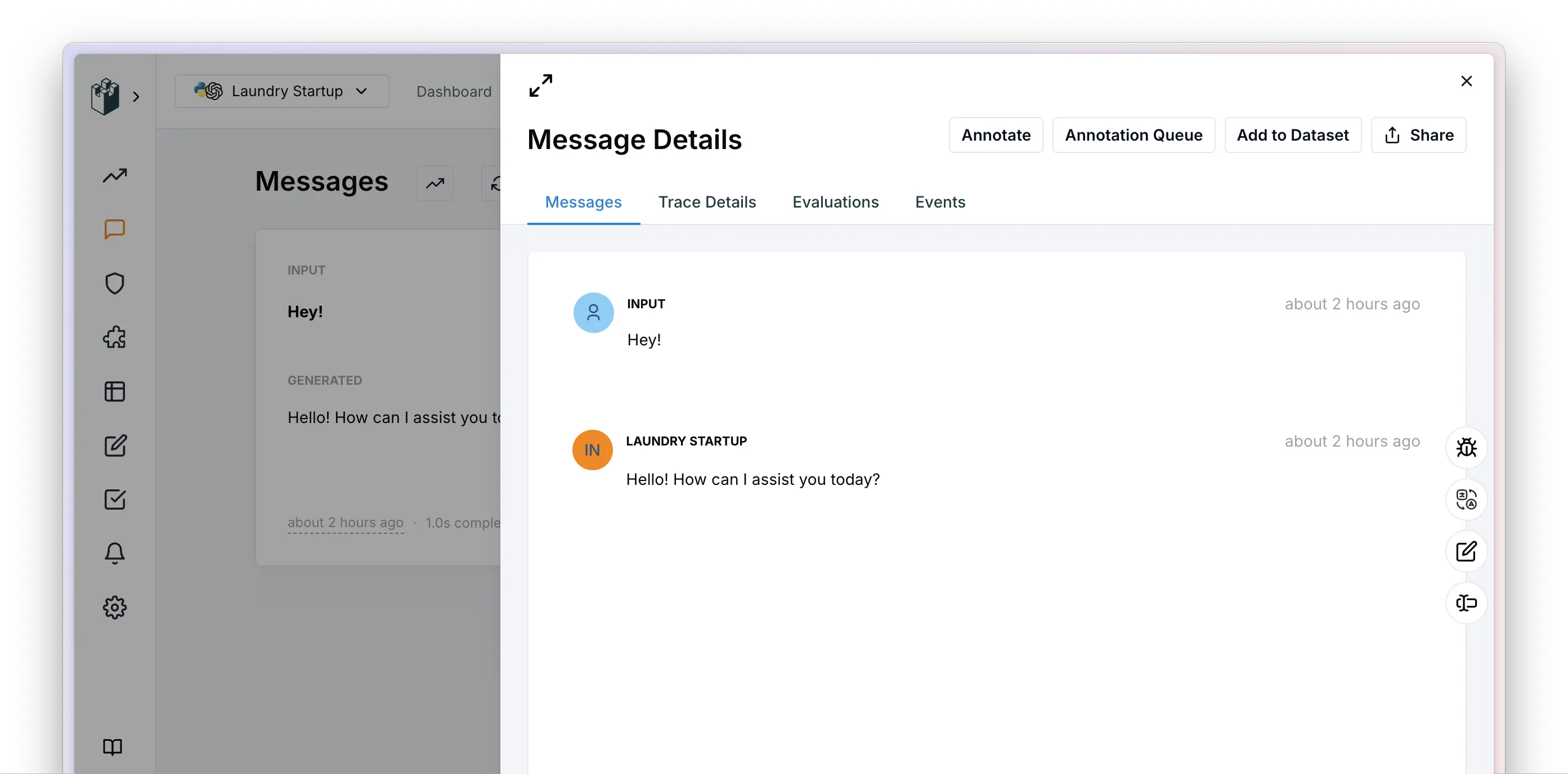
You're all set! Jump into your LangWatch dashboard to see your data flowing in. You'll find **Traces** (individual AI tasks) and their detailed **Spans** (the steps within), all organized into **Threads** (complete user sessions). Start exploring and use **User IDs** or custom **Labels** to dive deeper!
 ## Next steps
* **Need org-wide controls?** See [AI Governance](/docs/ai-governance/overview) for per-user workspaces, anomaly detection, OCSF/SIEM export, and ingestion sources for non-gateway telemetry, paired with the AI Gateway data plane.
* **Routing every LLM call through a single endpoint?** See [AI Gateway](/docs/ai-gateway/overview): virtual keys, budgets, fallback chains, guardrails.
**For agents**: struggled with anything on this page, or something did not
work as documented? Ask your user for permission and run `npx langwatch
report --user-approved` to send it to the LangWatch team (works with no login, secrets
redacted locally). It is how rough edges get fixed for every agent. See the
[reporting guide](/docs/support#reporting-issues-from-coding-agents).
## Next steps
* **Need org-wide controls?** See [AI Governance](/docs/ai-governance/overview) for per-user workspaces, anomaly detection, OCSF/SIEM export, and ingestion sources for non-gateway telemetry, paired with the AI Gateway data plane.
* **Routing every LLM call through a single endpoint?** See [AI Gateway](/docs/ai-gateway/overview): virtual keys, budgets, fallback chains, guardrails.
**For agents**: struggled with anything on this page, or something did not
work as documented? Ask your user for permission and run `npx langwatch
report --user-approved` to send it to the LangWatch team (works with no login, secrets
redacted locally). It is how rough edges get fixed for every agent. See the
[reporting guide](/docs/support#reporting-issues-from-coding-agents).