> ## Documentation Index
> Fetch the complete documentation index at: https://langwatch.ai/docs/llms.txt
> Use this file to discover all available pages before exploring further.
# Getting started with Langy
> Langy setup: enabling the agent, picking a model or signing in with Codex, and reviewing the first pull request it opens.
**Also check:** [How Langy works](/docs/langy/how-langy-works), [Models and Codex](/docs/langy/models), [Pull requests](/docs/langy/pull-requests)
* **On LangWatch Cloud:** Langy is available. Open the panel to get started.
* **On a self-hosted install:** the Helm chart deploys the Langy agent by default. If an admin disabled it, see [self-hosting](/docs/self-hosting/langy/overview).
Open the model picker in the composer. You bring your own model access, one of two ways:
* **Add a provider API key** for OpenAI, Anthropic, or another supported provider, then pick a model such as `gpt-5.6-terra` or `claude-opus-4-8`. See [Models](/docs/langy/models).
* **Sign in with your OpenAI account** to run Langy on your ChatGPT subscription through Codex, using a device-code sign-in instead of pasting a key. See [Codex](/docs/langy/codex).
Every model call, including Codex, goes through the LangWatch AI Gateway, so tracing, budgets, and policy apply the same way regardless of which you pick.
 Type a question in plain language into the Langy panel. Langy reads the traces and evals your question points at, then works toward an answer or a change. As it runs, its tool calls stream into the conversation as activity cards, so you can see which traces it searched and which tests it ran.
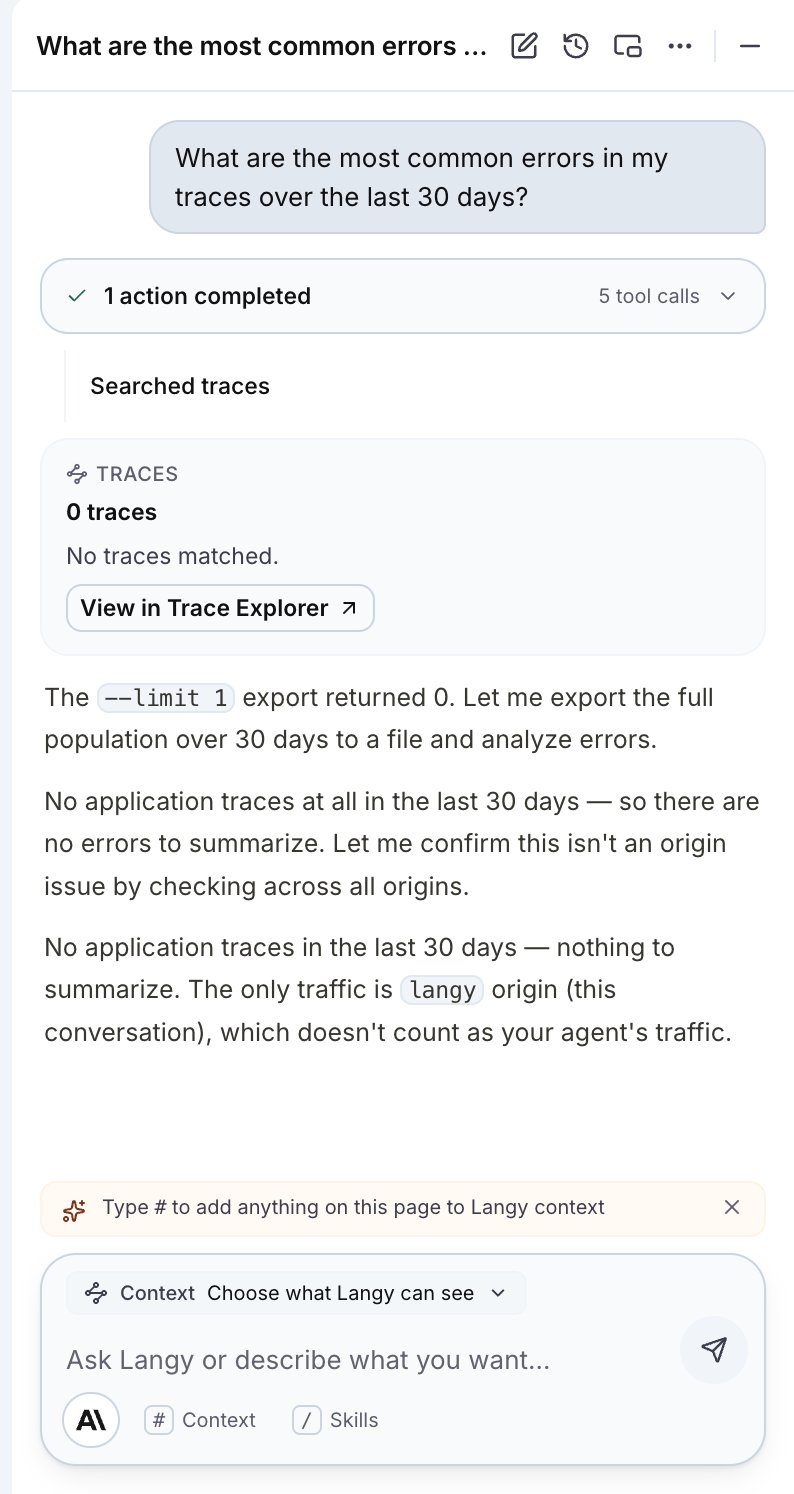 For the kinds of questions Langy answers, see [Ask Langy](/docs/langy/chat).
When Langy changes code, it opens a pull request on the repo you installed the GitHub App on. The PR is authored by the LangWatch bot and credits you with a `Co-authored-by` trailer and a "Requested by @your-login via LangWatch" note. The Scenario tests Langy wrote run in your CI on that PR, so you can read the diff and see the checks before merging.
You review and merge. Langy never merges its own PR. See [Pull requests](/docs/langy/pull-requests) for the full flow.
Langy can open pull requests only on repositories where the GitHub App is installed. If it reaches for `git` or `gh` on a repo the app is not installed on, it stops the turn and shows an install card in the chat.
For the kinds of questions Langy answers, see [Ask Langy](/docs/langy/chat).
When Langy changes code, it opens a pull request on the repo you installed the GitHub App on. The PR is authored by the LangWatch bot and credits you with a `Co-authored-by` trailer and a "Requested by @your-login via LangWatch" note. The Scenario tests Langy wrote run in your CI on that PR, so you can read the diff and see the checks before merging.
You review and merge. Langy never merges its own PR. See [Pull requests](/docs/langy/pull-requests) for the full flow.
Langy can open pull requests only on repositories where the GitHub App is installed. If it reaches for `git` or `gh` on a repo the app is not installed on, it stops the turn and shows an install card in the chat.