
Top 5 AI Prompt Management Tools of 2025
AI prompt management tools help teams version, test, evaluate, and safely deploy prompts that control LLM and agent behavior, making AI systems reproducible, observable, and reliable in production.
 Manouk Draisma · December 23, 2025 · LLM Evals
If you’ve shipped anything with large language models in the past year, you already know this truth: the prompt is the product.
A small wording change can turn a helpful assistant into a hallucinating one. A forgotten system instruction can quietly break compliance. A temperature tweak can change user trust overnight. And once you have more than a handful of prompts in production, things start to drift, fast.
That’s why AI teams are increasingly searching for prompt management tools.
Prompt management isn’t about writing clever instructions. It’s about controlling, testing, and understanding how prompts behave across models, versions, and real users. In 2025, that’s no longer optional, it’s infrastructure.
This guide explains what prompt management really is, why it matters for modern AI systems and agents, and which tools are leading the space today.
Definition: AI Prompt Management Tools
AI prompt management tools are platforms that allow teams to store, version, test, evaluate, and deploy prompts used in large language model (LLM) systems.
Unlike prompt engineering, which focuses on writing good prompts, prompt management focuses on operational control. It ensures prompts behave consistently across models, environments, and time.
In modern AI systems, prompts include:
-
Instruction text
-
Model selection
-
Parameters like temperature and max tokens
-
Tool or function schemas
-
System and user context
-
Safety and policy constraints
Prompt management tools treat all of these as a single, versioned unit.
What is AI prompt management?
Prompt management is the practice of treating prompts as versioned, testable, and observable assets, rather than one-off strings embedded in code.
In early prototypes, prompts often live in notebooks or inline function calls. That works - until you scale. As soon as multiple engineers, models, or environments are involved, it becomes impossible to answer basic questions like:
Which prompt version is live right now?
What changed last week, and did it hurt quality?
Does this prompt behave the same across models?
Why did the agent fail in production but pass locally?
Prompt management exists to answer those questions.
Modern prompts don’t just include text. They include model selection, parameters like temperature and max tokens, tool schemas, safety constraints, and sometimes entire multi-message conversations. Together, these define how an AI system behaves.
Managing prompts properly means teams can replay behavior, compare versions, test changes before deployment, and understand failures after the fact. In other words, prompt management is to LLM systems what version control is to software engineering.
Why prompt management matters even more for agents
AI agents rely on multiple prompts, not just one.
Typical agents include:
-
Planning prompts
-
Tool selection prompts
-
Execution prompts
-
Reflection or evaluation prompts
-
Memory prompts
A small change to an early prompt can cascade through the agent and completely change its behavior. Because of this, prompt management tools must operate at the agent level, not just the single-call level.
This is why modern prompt management platforms increasingly integrate:
-
Trace replay
-
Step-by-step agent inspection
-
Agent simulations
-
Prompt-level evaluations inside workflows
What to look for in a prompt management platform
Teams evaluating prompt management tools usually ask the same core questions, even if they phrase them differently.
Can we update prompts without breaking production?
Can we see what changed and why?
Can we test prompts before rollout?
Can we tie prompt changes to measurable outcomes?
Can we understand failures after users report them?
A modern AI prompt management platform typically includes:
-
A central prompt library that stores prompts with metadata and version history
-
A testing or sandbox environment to compare prompt behavior safely
-
Evaluation tooling to measure quality, safety, consistency, and cost
-
Traceability linking prompts to real executions
-
Deployment controls to prevent unsafe changes from reaching users
Tools that only store prompt text without evaluation or traceability are usually insufficient for production systems.
Strong prompt management platforms answer all of these by combining prompt storage with testing, evaluation, and observability. The more complex your AI system is - especially if it includes agent, the more important that connection becomes.
The top AI prompt management tools in 2025
-
LangWatch - prompt management built AI agents

LangWatch is a prompt management and AI quality platform designed for production AI systems and agents.
Definition:
LangWatch is a prompt management tool that connects prompt versions directly to evaluations, agent simulations, and production traces, allowing teams to measure the real impact of prompt changes before release.
Instead of asking “How do we store prompts?”, LangWatch starts with a more practical question: How do we know a prompt change actually improved our AI system?
In LangWatch, prompts live in a central hub where they’re versioned and documented, but they’re never isolated. Each prompt version is directly connected to evaluations, traces, and critically, agent behavior.
When a prompt changes, teams can replay real production traces against the new version, compare outputs side by side, and see whether the change improves accuracy, consistency, or safety. This makes prompt iteration evidence-driven rather than intuition-based.
LangWatch is also one of the few platforms that treats agent simulations as first-class. Instead of testing prompts in isolation, teams can simulate full agent workflows and observe how prompt changes affect planning, tool usage, and final outcomes.
LangWatch is best suited for teams building production AI systems where collaboration is key. Having developers full flexibility running Prompts via CLI and fully connected with Github while Product Managers, analysts or people prefer platform over code, using prompt management. directly on he LangWatch platform
-
PromptLayer - lightweight prompt tracking and analytics
PromptLayer focuses on logging and tracking prompt usage across model APIs. PromptLayer sits between experimentation and production. It’s less about deep observability and more about managing the creative and operational lifecycle of prompts.
It captures prompt executions, tracks how prompts evolve over time, and provides visibility into cost and latency. For teams looking for a simple hosted layer to understand prompt drift and performance trends, PromptLayer can be effective. Some key features are: Prompt execution logs, Dynamic parameter binding, Prompt diffing and lineage tracking.
However, it’s less oriented toward agent workflows or deep production debugging. Its limited in their observability depth. Prompt-level visibility is strong; system-level insight is more limited. No in-house model instrumentation: It wraps around api provider but doesn’t instrument self-hosted or local inference, limiting the flexibility for private deployments.
-
DSPy programming - not prompting
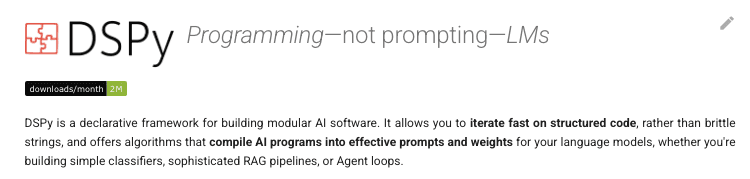
DSPy takes a fundamentally different approach to prompt management.
DSPy is an open-source framework created by researchers at Stanford that aims to move prompt engineering away from trial-and-error and toward a more systematic, programmatic approach. Rather than repeatedly tweaking prompts by hand, developers describe their systems using declarative components Python functions that capture discrete reasoning or processing steps. DSPy then compiles these components into an optimized end-to-end pipeline.
These components are treated as trainable units. They can be evaluated, improved, and versioned using real feedback data, enabling teams to iterate based on measurable performance instead of guesswork. Experimental results have shown that DSPy-based pipelines can significantly outperform traditional few-shot prompting, reinforcing the idea that prompts are better handled as learnable programs than static text.
Core capabilities
-
Structured, declarative components
Each reasoning step is expressed as a Python module with explicit input and output definitions, helping maintain consistency and clarity across prompts. -
Composable pipelines
Retrieval, reasoning, and transformation steps can be assembled into flexible workflows that evolve over time without rewriting the underlying logic. -
Automated prompt improvement
DSPy includes compilation and optimization mechanisms that evaluate module behavior on datasets and automatically adjust prompts to optimize for accuracy, reliability, or other chosen objectives. -
Reproducibility and versioning
Because pipelines are code-defined and versioned, teams can reliably reproduce results and understand how changes impact outcomes.
DSPy is especially compelling for research-heavy teams, but it comes with a learning curve and limited production tooling. Most teams pair it with other systems once models move beyond experimentation.
We at LangWatch are pretty fan of LangWatch as most of our users know. That's why within LangWatch we automatically build the Prompt Optimizers of DSPy within the workflow builder. Which brings the advantage of DSPy over with less complexity.
-
PromptHub
Best for: Teams looking for a centralized, hosted environment to organize, test, and evolve prompts without building internal tooling.
PromptHub is designed to bring structure to fast-moving teams by offering a shared workspace where prompts can be created, experimented with, and managed alongside their configurations. Instead of scattering prompts across notebooks or scripts, everything lives in one place, making collaboration and iteration more predictable.
Each prompt is stored with its parameters, context, usage notes, and performance signals, giving teams visibility into how changes affect results over time.
Key features
-
Multi-model experimentation
Test the same prompt across providers such as OpenAI, Anthropic, or Azure to compare quality, cost, and behavior across model backends. -
Hosted APIs for runtime use
Retrieve the latest prompt version via REST, inject variables dynamically, and deploy directly into applications, effectively treating prompts as a managed service. -
Version-controlled prompts
Prompts are stored in a Git-backed system, enabling branching, reviews, and rollbacks using familiar development workflows. -
Prompt chaining and pipelines
Chain prompts together in the playground to support multi-step reasoning or transformations, with built-in checks that prevent unsafe or underperforming prompts from being deployed.
Constraints
PromptHub offers basic cost and latency tracking but limited enterprise compliance, deep observability, and large-scale performance when managing thousands of prompt versions.
-
Langfuse: OSS LLM observebability with Prompt Management
Langfuse is an open-source platform focused on LLM observability that includes prompt management capabilities as part of its broader tracing and monitoring infrastructure.
Best for: Solo developers that need open-source tracing and runtime visibility into LLM applications.
Langfuse focuses on observability for LLM systems, providing detailed execution traces that surface latency, token usage, and cost across different steps in an AI pipeline. This visibility helps teams understand how models behave in real environments and where performance issues emerge.
The platform integrates with common agent and orchestration frameworks like LangChain and LlamaIndex, making it easy to add tracing without restructuring existing applications.
Key features
-
End-to-end tracing
Capture detailed execution paths across prompts, tools, and chains, including timing, token counts, and cost attribution. -
Production observability
Monitor live behavior, debug failures, and identify bottlenecks directly from real user traffic. -
Open-source and self-hosted
Full access to the codebase enables customization, self-hosting, and alignment with internal compliance or data residency requirements. -
Active ecosystem
Community-driven development with regular updates and extensions contributed via GitHub.
Constraints
Langfuse emphasizes tracing and monitoring, but provides limited support for structured experimentation, advanced evaluations, or simulation-based testing without additional tooling. Their OpenTelemetry is available but not native and its most convenient for developers only, when you want to collaborate with others on the team that makes it harder.
Which prompt management tool is right for you?
If you’re experimenting with a few prompts, almost any tool will help. But once you’re shipping AI features continuously, especially agent-based systems and collaborating with multiple different teams the question changes.
You don’t just need to store prompts. You need to trust them.
That trust comes from seeing how prompt changes affect real behavior, under real conditions, before users are impacted. This is where platforms like LangWatch stand out. By tying prompt management directly to evaluations, simulations, and production traces, they turn prompt iteration into a controlled engineering process rather than trial and error.
LangWatch is especially well suited for teams that consider prompts a core part of their system architecture. By using a unified schema, it connects prompt versions, evaluations, and execution traces into a single coherent model, which makes managing prompts far more reliable in complex, production-grade AI environments.
Every platform embodies a different way of working. The best fit is the one that keeps feedback flowing and turns routine testing into clear, trackable improvements, while making prompt behavior easier to understand and reinforcing your team’s confidence in the models they ship.
Frequently asked questions about prompt management
What’s the difference between prompt engineering and prompt management?
Prompt engineering focuses on writing effective prompts. Prompt management focuses on storing, versioning, testing, and evaluating those prompts at scale.
Why do teams need prompt management tools?
Because manual edits and spreadsheets don’t scale. Prompt management tools provide traceability, reproducibility, and confidence as AI systems grow.
Can prompt management replace fine-tuning?
No. Fine-tuning changes the model itself. Prompt management helps teams understand whether fine-tuning is necessary by showing how much behavior can be improved through better prompts, configuration, and evaluation.
AI prompt management tools help teams version, test, evaluate, and safely deploy prompts that control LLM and agent behavior, making AI systems reproducible, observable, and reliable in production.
Put this into production with LangWatch.
Trace your agents, run evaluations, and turn failures into repeatable tests.