
Your AI engineer best friend
Langy is an automated AI engineer inside LangWatch. It reads your traces, writes the tests, opens the pull request, and proves the fix in your CI.
Ask in plain language. What comes back is a diff with green checks attached.
Rolling out to LangWatch teams now. Runs on your own model keys.
Hey, I’m Langy!
Just type away, or start with one of these.
/ for skills · # to add context
Ask Langy or describe what you want…
A session, end to end
Four questions teams actually ask Langy. Pick one and watch what it does about it, from reading the traces to the pull request waiting for review.
Pick one to replay the session. On your project, Langy answers from your own traces and your own repository.
Support says customers are getting refunds they shouldn't. What's happening?
The policy check is skipped whenever retrieval comes back empty. 214 conversations went down that path, and every one of them issued the refund without checking eligibility first.
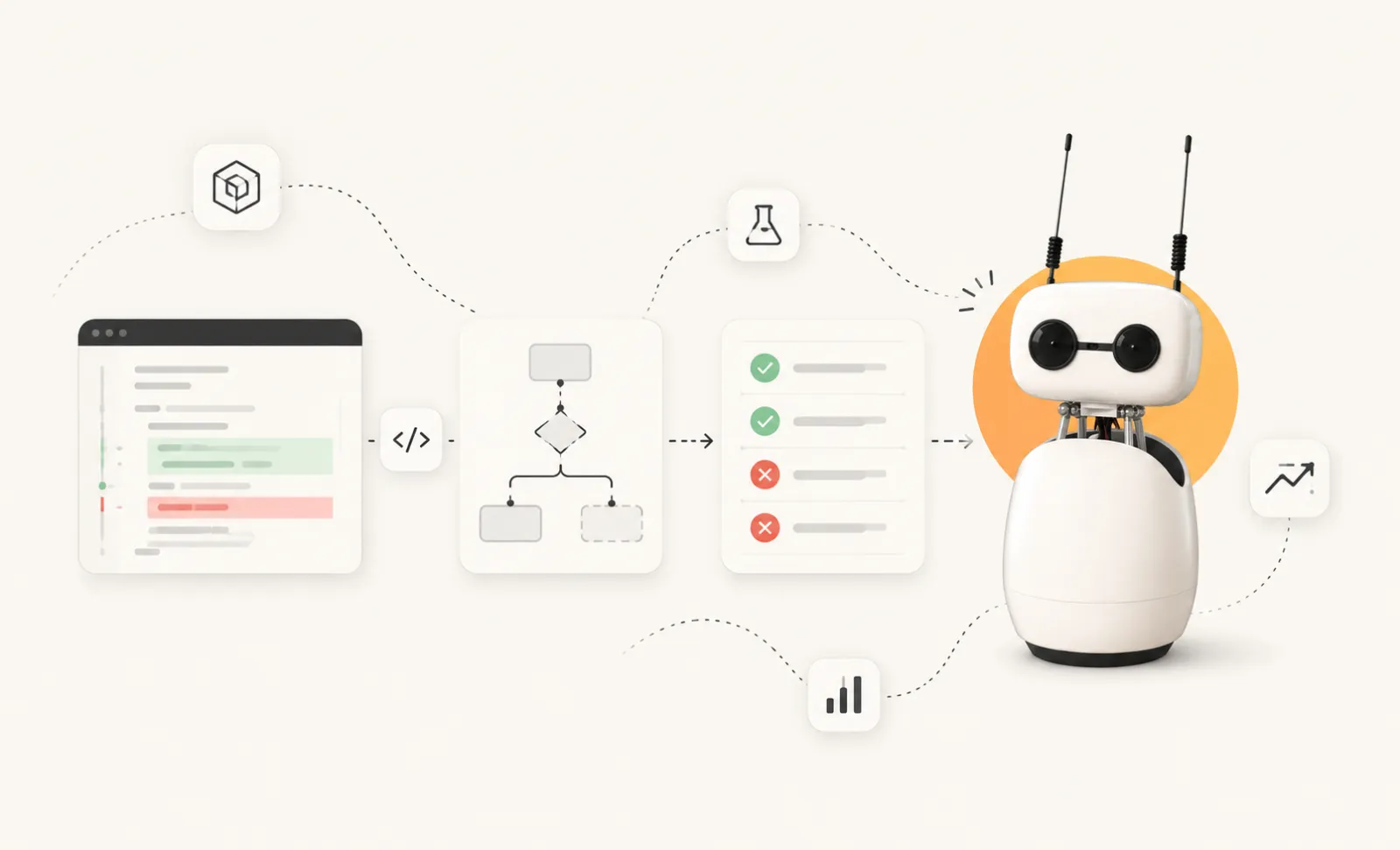
We gave Langy a body for a while, and it tested our voice agent on its own.
Read more on LangyWhat your automated AI engineer does
The work you already do when you improve an agent, automated up to the pull request.
Point Langy at a few thousand conversations and it clusters how your agent actually behaves into the problems worth fixing. The alternative was an engineer reading a handful by hand and extrapolating.
The evaluations and Scenario simulations that hold the behaviour still, then it runs them to find where your agent breaks.
The single conversation behind a complaint becomes a test you keep, so the same failure cannot come back quietly.
Connected to your GitHub, working on your real repository, with the change explained and the reasoning attached.
The simulations Langy wrote run on the pull request. Review is about the change itself rather than about whether to trust it.
Compare two model or prompt versions, translate prompts across languages, and set up the signals that catch a problem coming back.
Who gets what out of it
Any agent worth building has an evaluation pipeline and a scenario suite behind it. Langy is at home in the platform and in the codebase, so the people who know the domain stop being blocked on the people who know the code.
Find the problems, improve the prompts, and add the scenarios your domain actually needs, without waiting for an engineer to translate a wish into a diff.
Domain expertise lands as a pull request with tests behind it. You approve a diff instead of doing the triage, and keep your focus for the genuinely hard problems.
Find the one trace, spot the pattern behind it, and pull the metric that explains what the agent has been doing in production, or in the experiment you ran last week, at a glance.
Could you do this with your own Claude Code?
Yes, and that is the point. The LangWatch CLI lets your own coding agent reach everything on the platform, and Scenario is open source for the simulation testing. Wire those together and your agent becomes a genuinely good AI engineer for this. Langy is the same thing with the harness already assembled and sitting on your data.
An engineer you can actually let in
Skepticism is the right reaction to one more thing calling itself an AI engineer. Here is exactly what Langy can reach, and what it can never do on its own.
Langy runs in a fully sandboxed VM, and reaches anything sensitive only through your LangWatch account, where the credentials already live.
Bring the API key for the provider you already use, or run Langy on a coding-agent subscription you already pay for, like a Codex account.
Nothing touches your codebase without a human approving it. Langy opens the PR and stops there. It never merges.
Every Langy session is itself an agent run inside LangWatch, evaluated and priced with the same tools you use on your own agents.
Secret redaction is on by default in LangWatch, so secrets do not leak into context in the first place. LangWatch is OpenTelemetry-native, so any framework it traces is a framework Langy can work on.
Questions
What is an automated AI engineer?
A coding agent embedded in the platform where your AI product is observed and tested, doing real engineering work on it: agent evaluation and testing, trace analysis, prompt and code changes, pull requests for your team to review. A copilot helps a person type and a chat assistant answers questions about your dashboards. An automated AI engineer does the work and shows the diff.
What does Langy actually do for my team?
The work you already do when improving an agent, automated: digging up the trace behind a complaint, figuring out what went wrong, writing the evaluation or the scenario test that catches it, fixing the prompt, checking the fix held. You ask in plain language, and Langy comes back with findings, or with a pull request.
Can Langy improve my AI agent automatically?
Up to the pull request, yes. Langy finds the problems, writes the scenario tests and evaluations, drafts the fix, and opens the PR with the CI results attached. Merging stays with your team, so you get the speed of automation with a human review on every change that ships.
How do I test AI agents with Langy?
Tell it what the agent should and should not do. Langy turns that into Scenario simulations, multi-turn conversations that probe your agent the way a real user would, plus evaluations that score the outcomes. The tests run in your CI, so every future change gets checked against them, whoever wrote it.
Can Langy test voice agents?
Yes. Our launch demo is exactly that: Langy, plugged into a robot over MCP, testing our own customer-support voice agent by kicking off Scenario simulations itself. Voice agent testing works the same way as text, with simulated conversations scored against the rubric you set.
How does Langy spend tokens, and whose account does it use?
Yours. You bring your own API key for the model provider you already use, or run Langy on a coding-agent subscription you already pay for, like a Codex account. Every Langy session is itself traced and costed inside LangWatch, so you see exactly what each run spent.
Is it safe to give an AI engineer access to my code and data?
Langy runs in a fully sandboxed VM and operates only on your LangWatch account for anything sensitive, so credentials stay there. Secret redaction is on by default, so secrets do not leak into context. On the code side, Langy contributes to your GitHub exclusively through pull requests, so nothing touches your codebase without a human approving it.
Which frameworks does Langy work with?
Any agent framework or harness. LangWatch is OpenTelemetry-native, so if LangWatch traces it, Langy can work on it. Models from any provider too, including OpenAI, Anthropic, Bedrock, Azure, and ElevenLabs, on your own keys.
Point it at your agent
Most of what ships as an automated AI engineer is a chat box on top of dashboards. Langy has hands, and it shows its work: a pull request on a real repository and a green CI run on tests it wrote itself.