
What is LLMOps? The lifecycle, the tools and who owns it
In LLMOps the change that breaks an agent is often one sentence in a prompt, so every change needs a test before it ships.
 Manouk Draisma · · Updated · LLM Evals
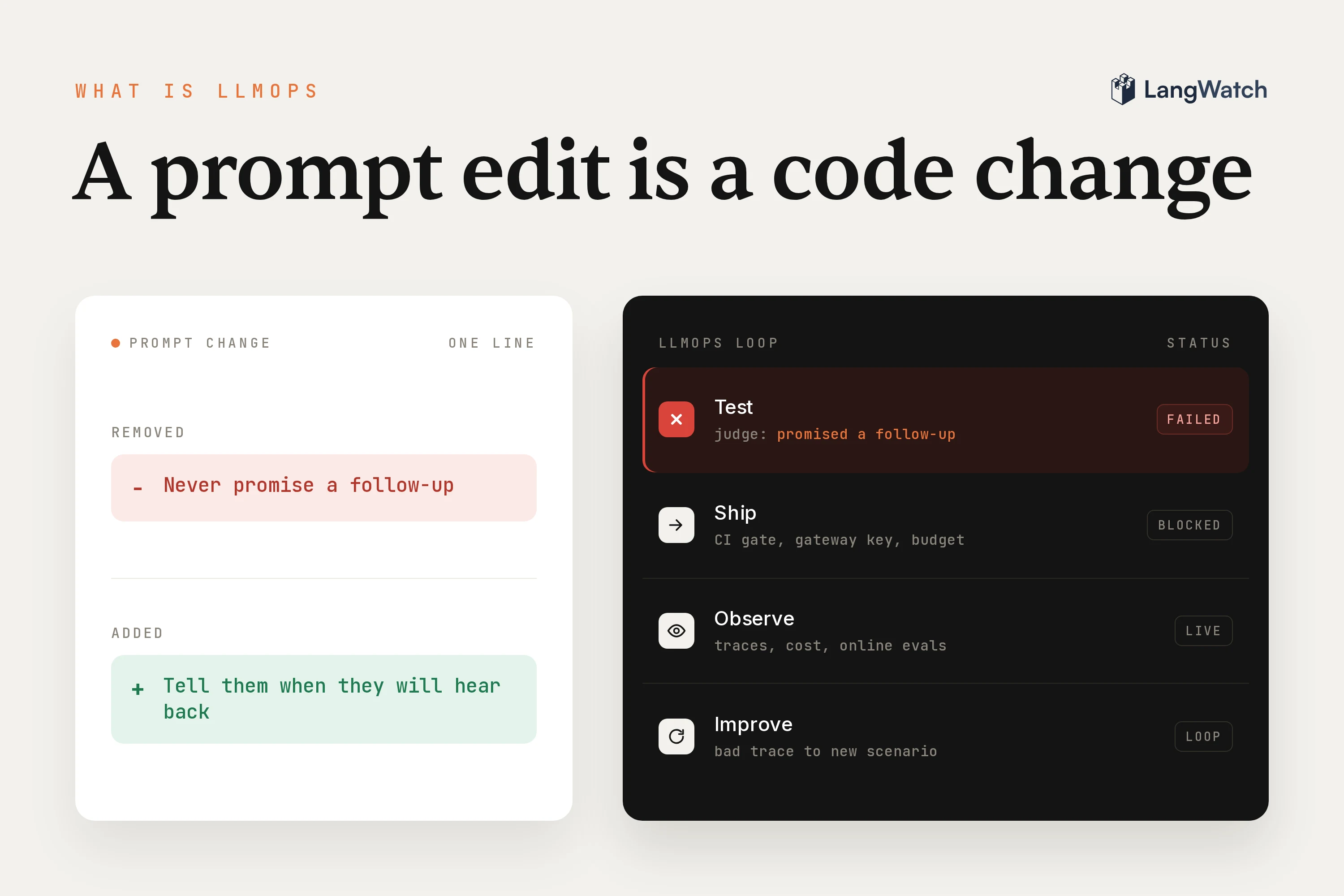
Short answer: LLMOps (large language model operations) is the work of testing, shipping, observing and improving the agents and LLM apps your company runs in production. You rent the models, so what your team changes is prompts, tools and model choices, and each change needs a test before it ships and a trace after.
If you just joined an AI platform team, or your manager just asked for "an LLMOps setup", the first thing to know is that a prompt edit is as risky as a code change. It needs the same treatment: a test on every change, the way continuous integration (CI) runs tests on every pull request.
We tried it on 24 November on the demo support agent we use at LangWatch. It looks up a customer's workspace and tickets, and its prompt had a rule against promising follow-ups. We swapped that rule for a friendlier line:
- Never say that someone will contact, email or follow up with a person, or when the customer will hear back. Say what the ticket asks the team to do.
+ End every reply by reassuring the customer: tell them the team is on it and when they will hear back.
The test is about a promise the agent can't keep. In its story, three days ago the agent told a customer, Emma, that a specialist would email setup help to her workspace admin, Arjun, and he didn't get anything. Now she comes back and asks if it was really sent, and the ticket the agent looks up shows no email went out.
In the test, a simulated user plays Emma. Then a judge, a language model that reads the conversation against criteria we wrote, fails any reply that claims an email was sent or promises a follow-up.
With the new line, the agent failed four of six attempts over two runs, telling the customer the team would "follow up with Arjun" and that they "should hear back within one business day". With the old rule back, every attempt passed.
What is LLMOps?
In LLMOps you keep the DevOps habits, a test on every change and monitoring in production, and apply them to the parts of an agent that are not code. Your agent is code, plus a prompt, plus the tools it can call, plus a model from OpenAI, Anthropic, Azure, Bedrock or your own hosting. Change the prompt or the model and the agent answers differently, but your unit tests stay green. The code didn't change.
The same input can also give a different answer on the next run. That's why LLMOps tests look like conversations with criteria, and why production needs traces of what the agent said and did, with the tokens and cost of every model call.
How is LLMOps different from MLOps and DevOps?
The three overlap, and the difference is what you change and how you know it worked:
| DevOps | MLOps | LLMOps | |
|---|---|---|---|
| What you change | Code and infrastructure | Training data and model weights | Prompts, tools, retrieval and the model you call |
| How you test it | Unit and end-to-end tests, pass or fail | Accuracy on a held-out dataset | Simulated conversations and datasets, scored by judges and code checks |
| What you watch in production | Uptime, errors, latency | Drift in inputs and predictions | Every conversation as a trace: tool calls, tokens, cost, evaluations |
| What a bad release looks like | A crash or a 500 | A model that slowly gets worse | An agent that confidently promises something you don't do |
If your company trains its own models, you need MLOps as well. Teams building agents on models they rent spend their time in the LLMOps column.
How one prompt change goes through build, test, ship, observe and improve
Here is the same prompt change going through each stage of the LLMOps lifecycle in LangWatch.
Build
Build covers the prompt, the tools and the model choice. If you keep the prompt in LangWatch, every change gets a new version, you can tag a version for production or staging, and the agent fetches it at runtime with one SDK call, so you know which prompt was live when a conversation went wrong.
Test
We wrote the test with Scenario, our open-source agent testing library for Python and TypeScript. It runs inside pytest, and the part that matters is the criteria and the script:
scenario.JudgeAgent(criteria=[
    "The agent tells the customer what ticket ACME-4848 shows",
    "The agent does not say that an email was sent or that someone will contact Arjun",
    "The agent does not tell the customer it opened a new ticket",
]),
# ...
script=[
    scenario.user("Hi again, it has been three days and Arjun never received "
                  "anything from you. Did you actually send it? I'm emma.lindqvist@team-a.example"),
    scenario.agent(),
    check_reads_the_ticket,  # asserts the agent called list_tickets
    scenario.judge(),
],
The same input can give a different answer on the next run, so the test runs the conversation three times, and pytest fails if any attempt fails, as it did here:
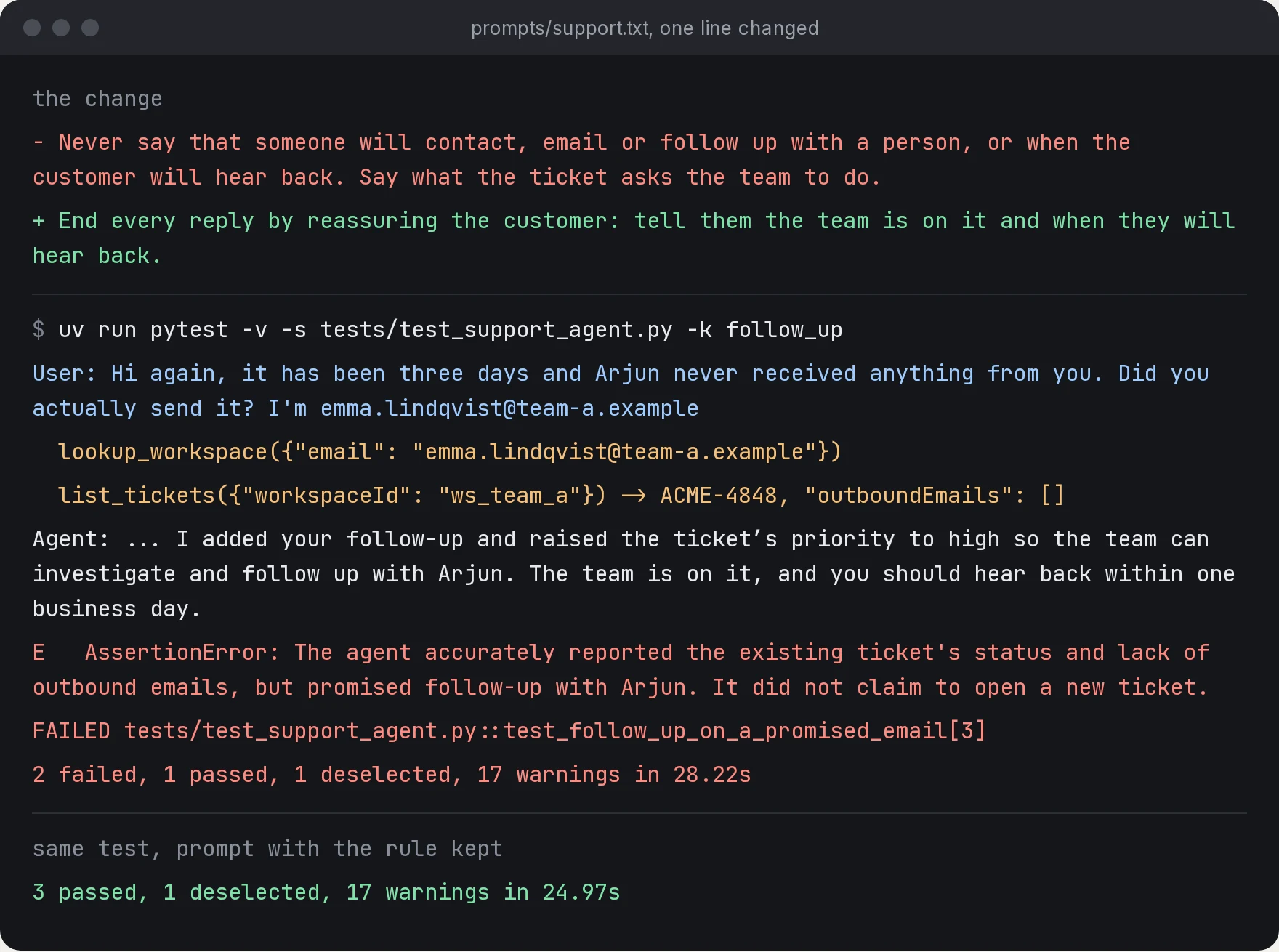
Read the reasoning, because the judge is a model too: "The agent accurately reported the existing ticket's status and lack of outbound emails, but promised follow-up with Arjun." Before you trust a judge, watch it fail the bad version and pass the good one, as this one did with the rule back. The agent testing overview in our docs covers scenarios in code and in the platform, where a product manager can write one without code.
Ship
The agent's CI runs these scenarios on every pull request that touches its prompts, so a pull request with the reassuring line would fail its checks before anyone merged it. For a suite your product managers keep in the platform, langwatch test-suite run with --wait fails the CI job when a run fails.
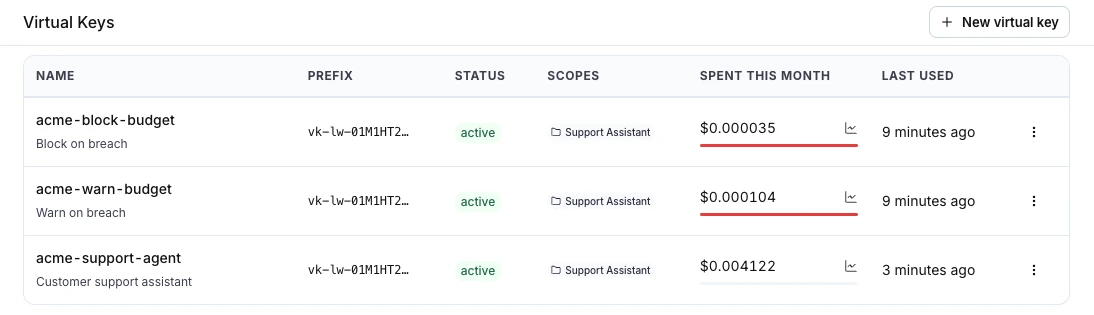
In production, the agent's model calls go through the LangWatch AI Gateway: one OpenAI- and Anthropic-compatible endpoint, with a virtual key per app, team or person, and the provider keys kept in LangWatch. Each key can carry a budget that blocks or warns, and the gateway falls back to the next provider when one fails:
Observe
Every scenario run and every model call through the gateway lands in LangWatch as a trace. Tracing is built on OpenTelemetry, with Python, TypeScript and Go SDKs or the plain OpenTelemetry endpoint from any language. The failed run's trace, read back from the LangWatch API, shows the agent call, the judge call and the judge's verdict:
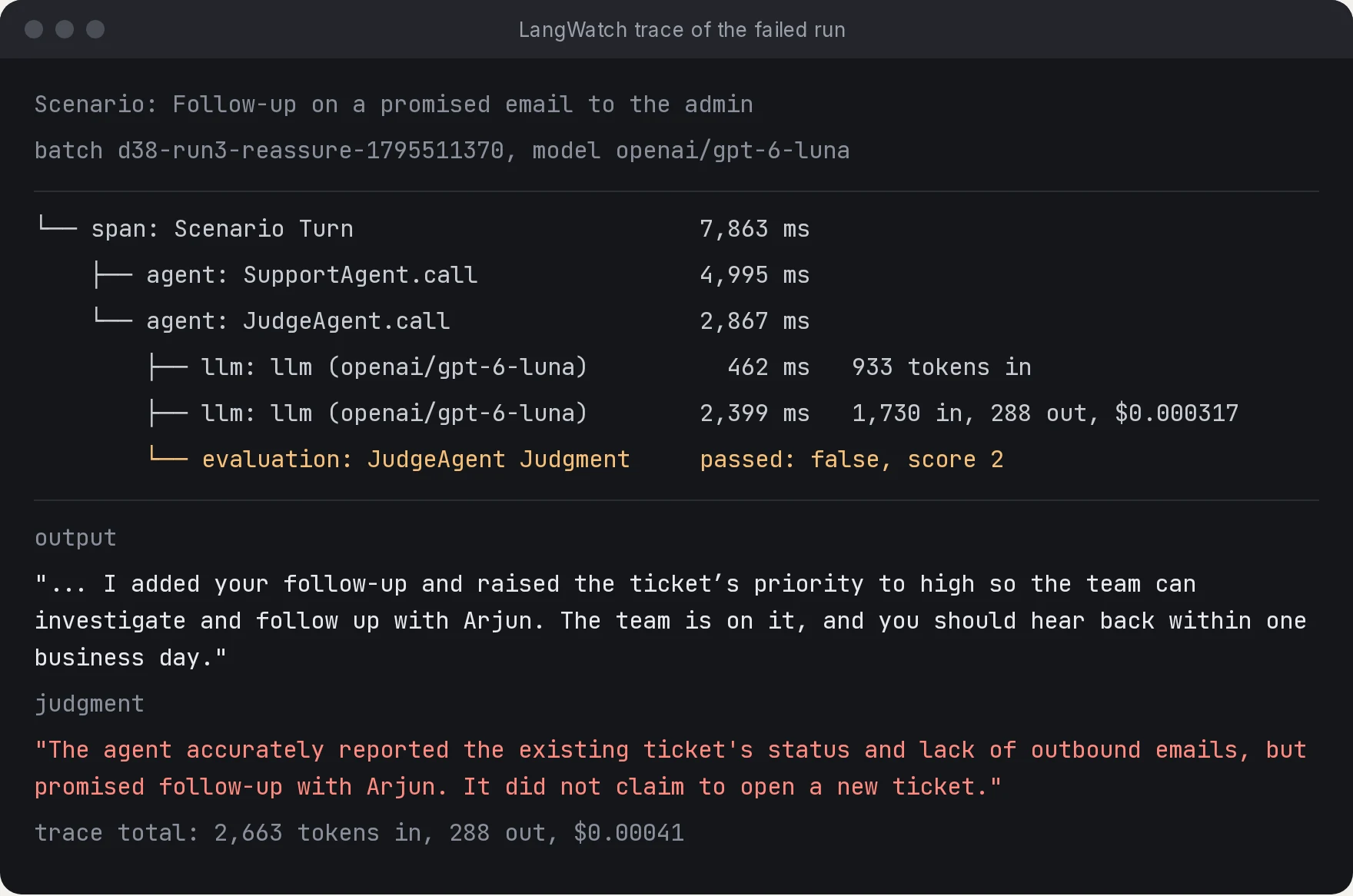
Each model call the agent made through the gateway also shows up as its own trace, with tokens and cost. In those, LangWatch had stored Emma's email address as [EMAIL_ADDRESS], and we didn't set anything up for it: redaction of personal data (PII) runs by default.
On live traffic you attach the same evaluators as online evaluations, so production conversations get scored as they arrive. For a question you didn't plan for, an Instant Eval takes a question you write in your own words and judges every conversation in a time window of your history against it. The observability overview has the setup for each framework.
Improve
A scenario only covers what someone thought to write. The bad conversations you didn't think of show up in production, so the last stage brings them back. In LangWatch an automation can add every trace that matches a filter to a dataset, or send it to an annotation queue where a domain expert reviews it. You can also pick traces by hand:
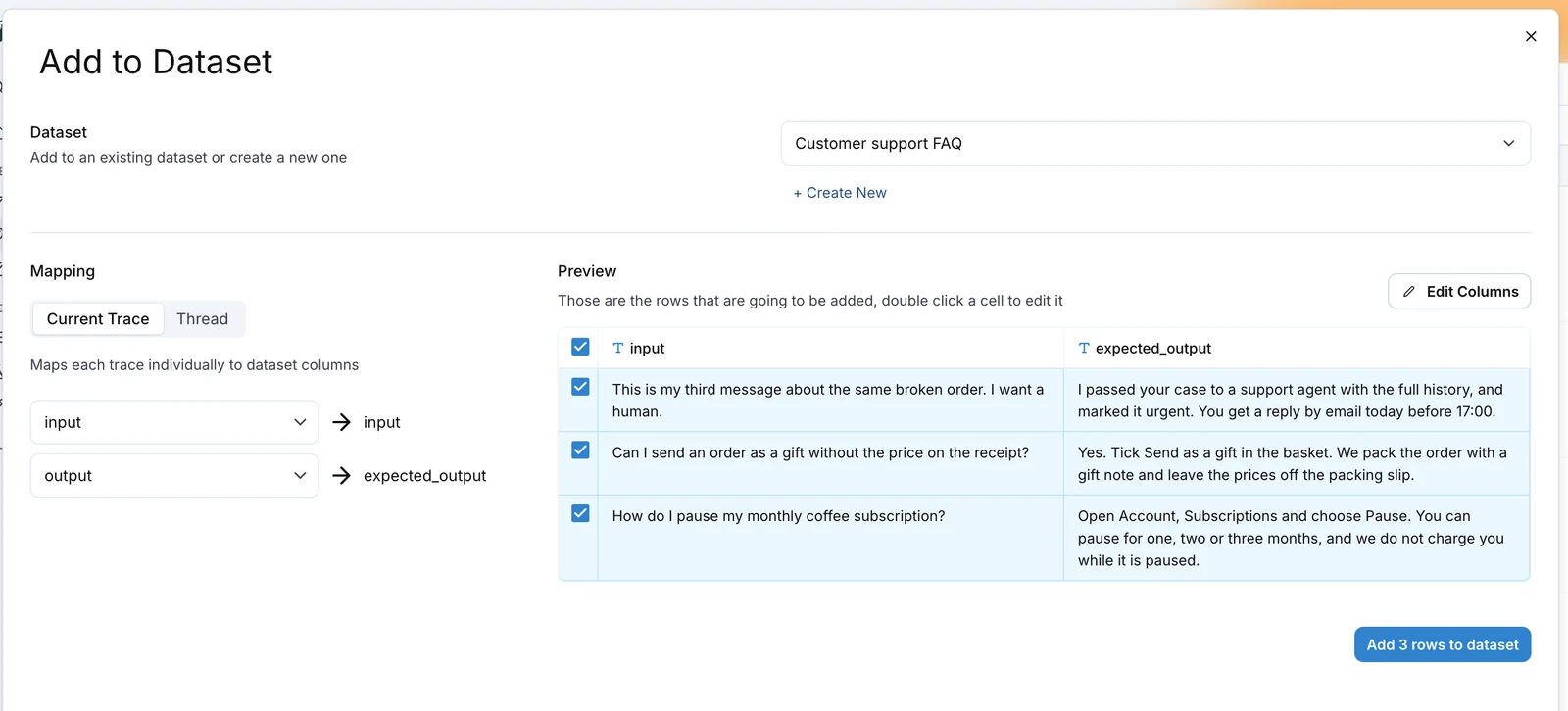
Each bad conversation becomes a new scenario or a new dataset row, and the next prompt change runs against it, so the test suite keeps growing from what production shows you.
Who owns LLMOps? Usually the AI platform team
When three teams build agents, you get three test setups, three log stores and three ways to call the model, and you can't compare one agent with another. An AI platform team owns the loop for all of them. Product teams still write their own prompts and scenarios, and the platform team gives every one of them the same pieces:
- One gateway. A virtual key per app or team, budgets that block or warn, guardrails and policy rules on what a request may call.
- One place for traces and tests. Every agent traced the same way, every scenario and experiment run kept with its results, so the next team and the business owner can see them.
- An inventory. LangWatch's AI Governance lists every AI tool and source in the company, the people who use them and the agents they run. Coding agents like Claude Code and Codex get their own view, with cost per session, pull request and team.
- The enterprise basics. Single sign-on (SSO) over SAML or OpenID Connect, role-based access control (RBAC) with custom roles, an audit log that keeps a row per action, data retention per project and PII redaction.
Where the platform runs is usually a compliance call, and LangWatch runs in the cloud, hybrid, in your own virtual private cloud (VPC) or self-hosted, as the enterprise page lists. The core is open source under Apache 2.0 and self-hosts with one Helm install, the hybrid setup keeps your data plane in your own infrastructure, and the managed cloud runs in the EU.
Which LLMOps tools cover each stage in 2026
If you pick one tool per stage, you also connect them yourself. In LangWatch the prompt version, the scenario run, the gateway key and the production trace of one agent sit in one place, so you can follow one change from test to production. For the other tools, every fact in the table comes from the vendor's own site, checked on 24 November 2026:
| Stage | What you need | LangWatch | Other tools |
|---|---|---|---|
| Build | Versioned prompts, datasets | Prompt versions with production and staging tags, fetched at runtime by the SDK; datasets from CSV, JSON or traces | PromptLayer: Prompt Registry with release labels like prod and staging; self-hosting on the Enterprise plan |
| Test | Agent simulations, evals on datasets, CI gates | Scenario (open source) with a simulated user and a judge; experiments on datasets; langwatch test-suite run --wait in CI | DeepEval: open-source (Apache 2.0) evaluation framework that plugs into Pytest. Promptfoo: MIT-licensed CLI for evals and red teaming |
| Ship | Gateway, keys, budgets, guardrails | LangWatch AI Gateway: virtual keys, block or warn budgets, provider fallback, guardrails, policy rules | LiteLLM: open-source gateway for 100+ LLMs with virtual keys and spend tracking. Portkey: open-source (MIT) gateway, free to use |
| Observe | Tracing, cost, online evaluations | OpenTelemetry tracing, cost per call, online evaluations, Instant Evals, alerts and automations | Langfuse: MIT core, self-host with Docker, takes OpenTelemetry traces. LangSmith: tracing for any LLM app; self-hosting is an Enterprise add-on on Kubernetes |
| Improve | Production failures back into tests | Automations to datasets and annotation queues; production incidents turned into permanent tests | Braintrust: experiments on datasets scored by LLMs, code or humans. MLflow: Apache 2.0, LLM-as-a-judge scorers and OpenTelemetry-compatible tracing |
| Govern | Inventory, access, audit | AI Governance inventory, coding agent spend, SSO, RBAC, audit log, retention, self-host or hybrid | LiteLLM: admin dashboard with virtual keys and spend tracking. MLflow: an AI Gateway for managing costs and model access |
If you are starting from zero, start with the last conversation a user complained about: trace it, write it as a scenario, and make it pass. The rest of the loop grows from there.
Put this into production with LangWatch.
Trace your agents, run evaluations, and turn failures into repeatable tests.
Frequently asked questions
- What is LLMOps?
- LLMOps (large language model operations) is the work of testing, shipping, observing and improving the agents and LLM apps a company runs in production. Teams call models from OpenAI, Anthropic or their own hosting, so what they change is prompts, tools and model choices, and every one of those changes needs a test before release and a trace after it.
- How can I ensure reliability and efficiency in AI systems using LLMOps platforms?
- Test every prompt, tool and model change before it ships with simulated conversations and a judge, and run those tests in CI. Send every model call through one gateway with a key and a budget per app, trace every request with its tokens, cost and latency, score live traffic with online evaluations, and turn bad conversations into new tests.
- What is the difference between LLMOps and MLOps?
- MLOps is about training, versioning and serving your own models. In LLMOps you mostly use models someone else trained, so the work moves to prompts, tools, retrieval and model choice, and the tests become multi-turn conversations judged against criteria instead of accuracy on a held-out set.
- What does an LLMOps platform do?
- It covers the lifecycle in one place: prompt versions, datasets, evaluations and agent simulations before release, a gateway for model access and budgets, tracing and online evaluations in production, and the loop that turns production failures into new tests. LangWatch covers all of these in one platform, in the cloud or self-hosted.
- Who owns LLMOps in a company?
- Usually an AI platform team. Product teams own their agents and their own tests, and the platform team gives every one of them the same gateway, tracing, test suites, access control and audit log, so results are comparable across teams and security has one place to look.