
PII redaction for LLM apps: keep customer data out of your traces
PII redaction for LLM apps masks emails, phone numbers, card numbers and names in your traces before they are stored, so you can debug every conversation without keeping your customers' personal data in your observability tool.
 Rogerio Chaves · · Governance AI
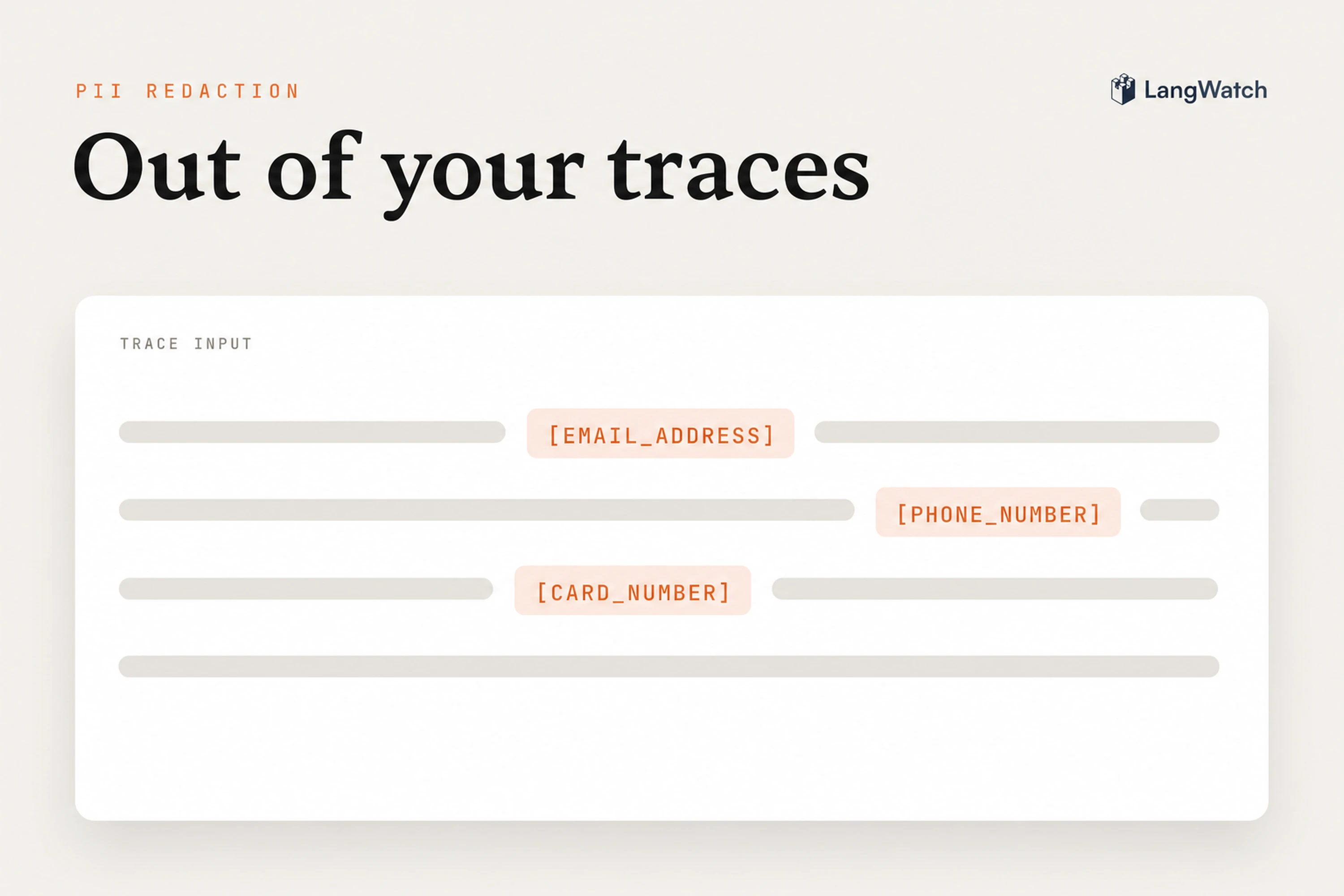
Short answer: PII redaction for LLM apps means masking personal data in your traces before they are stored. In LangWatch a data privacy policy does it at ingestion, replacing each email, phone number or card number with a typed marker, and it can also drop or restrict content per team, so you debug every conversation without keeping your customers' data.
Your users type things into chat boxes that they would never put in a form. Their phone number, their address, a card number "just to check", a full medical history. Every one of those messages ends up in your traces, because a trace records the whole prompt and the whole reply.
Why traces leak customer data
Traces leak personal data because they store the full text of every turn, tool call and retrieved document, and an LLM app's inputs are free text. You can't validate a chat message the way you validate a form field.
The leaks come from more places than the user's message:
- The user's message. People paste whatever they have, and they don't read your privacy notice first.
- Tool results. An agent that looks up an order gets back the customer's name, email and delivery address, and that result goes into the trace.
- Retrieved documents. A RAG app over support tickets or contracts puts chunks full of names into the context, and the context is in the trace.
- The system prompt. Teams put the customer's profile in the prompt to personalize the reply, so every call carries it.
- The model's reply. The model repeats the details back, sometimes with a typo that makes them harder to catch.
Then the trace gets copied. It goes into a dataset for an experiment, into an annotation queue for a reviewer, into an export for a bug report. Each copy is one more place your security team has to answer for.
How PII redaction works in LangWatch
In LangWatch one data privacy policy sets what gets stored and who can read it, at the organization, department, team or project level. It runs when a trace arrives, before anything is written, on every way traces come in.
That covers the SDKs and OpenTelemetry, the REST collector, the LangWatch AI Gateway and coding agent logs. You set it once in Settings > Data Privacy and every project under that scope follows it. The data privacy docs cover every control.
PII redaction replaces each personal value with a marker that says what it was, such as [EMAIL_ADDRESS] or [PHONE_NUMBER]. It has four levels:
| Level | What it masks |
|---|---|
| Off | Nothing |
| Essential (the default) | Emails, phone numbers, card numbers, IP addresses and national ids |
| Strict | Essential plus names, locations and more, with deeper detection that can add some latency |
| Custom | Exactly the entities you tick |
Card numbers and Brazilian CPF numbers are checked against their checksum before they are masked, so a random 16-digit order id stays readable. If one of your own id formats keeps getting caught, add it as an exception.
Secrets redaction is on by default too. API keys, tokens, private keys and database URLs become [SECRET], which matters for agents with shell or file tools, since they often print config files and environment variables into the trace.
Content controls decide whether text is stored at all, and who reads it. For each of input, output, system instructions and tool calls, you pick one of three:
- Captured stores it and shows it to everyone on the project.
- Restricted stores it and shows it only to the people you pick, such as admins or a custom group. Everyone else sees a placeholder that says who can read it.
- Dropped removes it at ingestion, for good.
A dropped span still keeps its tokens, cost, model, latency and status. So you can drop every input on a sensitive project and still see what each conversation cost and where it was slow.
Stop PII before it reaches the model
Redaction in traces protects what you store. To keep personal data away from the model provider itself, block it on the way in with a guardrail in the LangWatch AI Gateway or in your code.
A gateway guardrail runs an evaluator on the request before it goes to the provider. Put a PII detection evaluator on the request direction, and a prompt with a card number in it never leaves your network and costs you no tokens. You can run the same check on the response, or on each streamed chunk.
If you don't route through the gateway, call the PII evaluator as a guardrail from your code and decide there whether to block the call or clean the text first.
Redaction and evaluation also work together. When a value was already masked, the PII evaluator still counts the marker as a detection. So your PII monitor keeps showing how often users share personal data, even though none of it is stored.
What to redact and what to keep for debugging
Mask the values and keep the rest of the conversation. You almost never need to see the actual phone number to fix a bug, and you almost always need to see that the user gave one and what the agent did next.
- Start on Essential everywhere. Emails, phones, cards and ids are the values that do real harm when they leak, and they are detected as the data arrives.
- Turn on Strict where names matter. Health, legal, HR and finance agents talk about people by name. Strict catches names and locations, and it can add some latency at ingestion, so use it on those projects instead of the whole organization.
- Restrict instead of drop when you can. A small on-call group can still read the full conversation when a customer escalates. Drop the content only when your policy says it may not be stored at all.
- Keep the markers. A conversation that reads "my number is [PHONE_NUMBER]" still tells you the agent was asked to call someone back, and that's usually what you need to reproduce the bug.
- Add exceptions for your own ids. An order number that looks like a phone number makes traces hard to read. Exceptions are regular expressions, and LangWatch refuses one that would also let real emails or card numbers through.
One limit to know: the policy covers traces. A row you already copied into a dataset or an export is a separate copy, so clean the data before you share it.
How well PII detection works
Detection quality varies a lot, and a regex is not enough. We ran 58 PII detectors on six tests and published the results in our PII detection benchmark.
- A plain regex left almost half the personal data in on our policy test. Formats like emails are easy, and names in free text are where it falls apart.
- Open models you can host yourself did far better, and the best of them fit on a single GPU. So detection doesn't have to mean sending your data to another API.
- Results change a lot by kind of text. Traces, business documents, code and logs, and other languages all rank the detectors differently, so check the test that looks like your traffic.
Regulated industries: where the data lives
For banks, insurers and health companies, where the data sits matters as much as what is masked. LangWatch runs in four ways, and in two of them your trace data never leaves your own infrastructure.
| Setup | Who runs what | Where trace data lives |
|---|---|---|
| LangWatch Cloud | We run everything | Our cloud |
| Cloud Enterprise | We run it on dedicated single-tenant instances | The region you choose |
| Hybrid | We run the app, you run ClickHouse and S3 | Your VPC |
| Self-hosted | You run the full stack on AWS, Azure, GCP or bare metal | Your infrastructure, air-gapped if you need it |
The self-hosting docs cover each setup. LangWatch is open source, and the self-hosted edition runs the same software as our cloud.
Add single sign-on and a retention period per team, and you can answer the first things your security team will ask: what is masked, who can read the rest, and where it all lives.
Put this into production with LangWatch.
Trace your agents, run evaluations, and turn failures into repeatable tests.
Frequently asked questions
- What is PII redaction in an LLM app?
- PII redaction replaces personal data, such as emails, phone numbers, card numbers and names, with a typed marker like [EMAIL_ADDRESS] before the text is stored. In an LLM app your traces need it, because they record every prompt, tool call and reply your users send.
- Does PII redaction change what my app sends to the model?
- Not in LangWatch. The data privacy policy changes what LangWatch stores and who can read it, and the request to the model provider stays the same. To stop personal data from reaching the provider, put a PII detection guardrail on the request in the LangWatch AI Gateway or in your code.
- Is regex enough to detect PII?
- Regex is a good start for formats like emails and card numbers, and it misses names, addresses and personal data written in free text. On our PII detection benchmark, a regex baseline left almost half of the personal data in, far behind the best detection models.
- Can I still debug my agent if its traces are redacted?
- Yes. Redaction swaps the value for a marker that names what it was, so you still see that the user gave a phone number and what the agent did with it. Tokens, cost, latency, model and the span tree stay intact, even when you drop the content completely.
- Where is my trace data stored when I use LangWatch?
- You choose. LangWatch Cloud, Cloud Enterprise on dedicated instances in the region you pick, hybrid where the trace data stays in your own VPC, or fully self-hosted on AWS, Azure, GCP or bare metal, air-gapped included.