

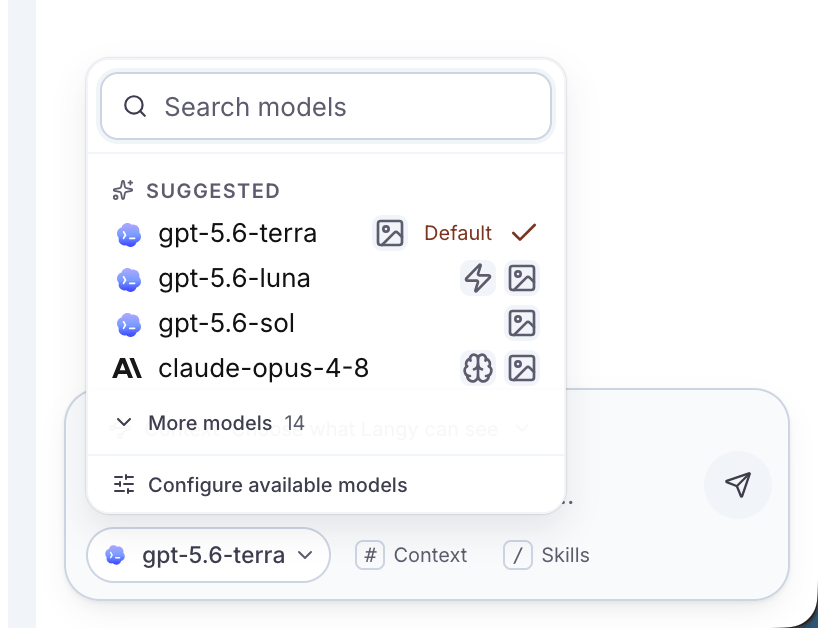
The Langy model menu. A short shortlist at the top (the gpt-5.6 family and claude-opus-4-8), then More models expands the full grouped catalog from your project's enabled providers.
The model menu
The menu has two parts:- Shortlist. A small derived list, not a fixed roster. It leads with Langy’s current default, then your current selection, then one representative each from the quick, balanced, and reasoning groups. Named families include
gpt-5.6-terra(default),gpt-5.6-luna(fast),gpt-5.6-sol, andclaude-opus-4-8. - More models. Expands the full catalog over every provider you have enabled on the project, grouped by capability. Toggle it back with Fewer models. Type a search query to collapse the split and search the whole catalog at once.
The exact number of models under More models depends on which providers you have enabled and
which models each exposes. There is no fixed count.
Langy’s model role
LangWatch resolves models by role. Langy has its own role, separate from the others, so changing Langy’s model does not change what your playground, evaluations, or workflows use.
Setting a model in the Langy composer sets the Langy role for the project.
Bring your own key
Langy uses your own provider accounts. Add a provider API key once in the model-provider settings, and Langy (and the rest of the platform) can use that provider’s models. Supported providers include OpenAI, Anthropic, Gemini, Azure, Bedrock, Vertex, and more (around 14 in total). Every provider except Codex is configured with an API key. Codex is configured by signing in with your OpenAI account instead. See Run Langy on your own OpenAI plan. Provider keys are stored encrypted at rest. They are decrypted only when a call needs them, and they are never returned over the API.How Langy’s model calls are routed
Langy never calls a provider directly. Every Langy LLM call rides a per-project virtual key through the LangWatch AI Gateway. That means the same controls apply to Langy that apply to any other traffic on your project:- Tracing. Every call is traced, with tokens and cost, in your own LangWatch project.
- Rate limits. Your gateway rate limits and budgets apply.
- Model policy. The gateway enforces which models are allowed, server-side, as a second check on top of the picker.
Also check: Token usage and cost, Data flow and
privacy.