The LangWatch AI Gateway is a single OpenAI- and Anthropic-compatible endpoint that every application, SDK, or coding CLI in your organization can send LLM traffic to. The gateway applies organisation-wide policy, attribution, budget enforcement, caching, guardrails, and fallback in the path of every request — and emits per-tenant OpenTelemetry traces that land in each project’s LangWatch workspace.Documentation Index
Fetch the complete documentation index at: https://langwatch.ai/docs/llms.txt
Use this file to discover all available pages before exploring further.
~11 µs of gateway-side overhead at 5k RPS sustained. Written in Go with chi + in-process JWT verification. The hot path sits in front of every LLM call — it has to be close to free.
Try it in 30 seconds
Swap your OpenAIbase_url + api_key and you’re done:
Why an AI Gateway?
Most teams start with “one app, one provider API key, one language SDK.” That stops working the moment a second team, a second app, or a second model provider shows up:- Credentials proliferate (developer laptops, CI environments, Kubernetes secrets) with no revocation story.
- Cost governance becomes guesswork — no one owns the team-level or project-level budget.
- Observability is fragmented — each app emits traces differently (or not at all).
- Reliability suffers — one provider outage takes down every surface that hard-coded that provider.
gateway.langwatch.ai (or your self-hosted URL) carrying a LangWatch virtual key. From the application’s perspective, nothing else changes — the OpenAI SDK still works, the Anthropic SDK still works, Claude Code and Codex still work — but every request now carries policy, budget enforcement, and observability.
What it gives you
- OpenAI-compatible endpoint at
/v1/chat/completions,/v1/embeddings,/v1/models, etc. Drop inOPENAI_BASE_URL=https://gateway.langwatch.ai/v1andOPENAI_API_KEY=lw_vk_live_…and every existing OpenAI-SDK codebase works unchanged. - Anthropic-compatible endpoint at
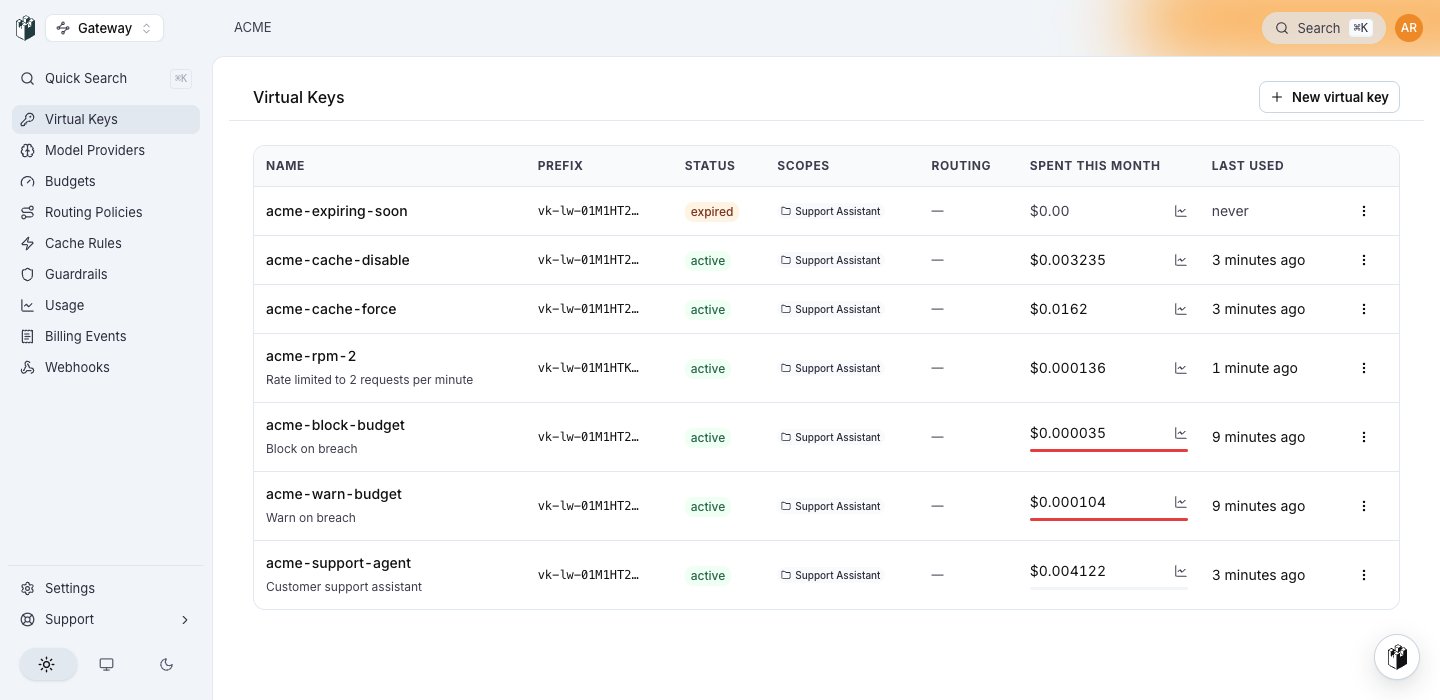
/v1/messagesso Claude Code and native Anthropic SDKs work by settingANTHROPIC_BASE_URLandANTHROPIC_AUTH_TOKENto your gateway URL and a LangWatch virtual key. - Virtual keys — LangWatch-issued credentials (
lw_vk_live_<ulid>) with project/team/org scope. Show-once secrets, peppered-HMAC-SHA256 hashed, rotatable, revokable within 60 seconds. - Hierarchical budgets — enforce spend limits at organisation, team, project, virtual-key, or principal scope with windowed periods (minute → total) and soft-warn or hard-block semantics.
- Per-request guardrails — invoke your LangWatch evaluators inline on the request, response, or each streaming chunk. Decisions:
allow,block,modify(redact). - Tool / MCP / URL policy — block or allowlist tool calls, MCP server references, or outbound URLs by regex before the request ever leaves your gateway.
- Caching passthrough — Anthropic
cache_controlmarkers are forwarded byte-for-byte by default (protecting your 90% cache discount). Override per-request withX-LangWatch-Cache: respect|force|disable. - Automatic fallback — per-virtual-key fallback chain (e.g. OpenAI → Anthropic → Bedrock) triggers on 5xx, timeout, 429, or circuit-breaker-open. 400/401 client errors never trigger fallback.
- Per-tenant observability — every request emits a LangWatch trace to the owning project with
langwatch.virtual_key_id,langwatch.project_id,langwatch.principal_id,langwatch.cost_usd, cache-hit token breakdown, and status. Shared multi-tenant gateway, per-tenant trace routing. - Coding-CLI integrations — preserves the tool-call streaming deltas that Claude Code and Codex depend on. Documented setup for the major coding assistants in CLI Integrations.
- Self-hostable — ships as a Helm chart alongside the LangWatch app. Horizontally scales, serves traffic during control-plane outages (with bootstrap mode).
Architecture at a glance
github.com/maximhq/bifrost/core as a library for provider-specific dispatch (Azure deployment name quirks, Bedrock regional inference profiles, Vertex OAuth refresh, streaming format divergences across providers). LangWatch owns everything above the dispatch line: auth, policy, budgets, guardrails, per-tenant observability.
Why a separate Go service? Sub-millisecond overhead on the hot path matters when the gateway sits in front of every LLM call. Go with chi + in-process JWT verification gives us ~11 µs gateway-side overhead at 5k RPS sustained. A Python/FastAPI or Node/Hono gateway cannot reach those numbers.
Why embed, not fork? Bifrost’s provider dispatch is where hundreds of engineer-hours per provider have been invested (native SDKs for every provider, streaming format normalisation, tool-call delta reassembly, reasoning-token handling). That’s the part we consume as a library. The policy / governance / observability layers on top are ours — the product.
When to use the gateway vs. the LangWatch SDK directly
Both ship in LangWatch. They solve different problems:| Need | Use |
|---|---|
| ”Trace my existing provider calls without changing credentials” | LangWatch SDK — point it at your app, it instruments. Keep your provider keys. |
| ”Give the marketing team an LLM key they can’t leak, with a $500/month cap” | AI Gateway — mint a virtual key with a budget, share the VK. |
| ”Switch all internal apps from OpenAI to Anthropic for a week” | AI Gateway — flip model_aliases on the VKs involved. Zero code change. |
| ”Ship a coding CLI to every engineer with observability” | AI Gateway + CLI integration — set OPENAI_BASE_URL or ANTHROPIC_BASE_URL on every dev machine. |
| ”Guardrail the production chat surface for PII and prompt injection” | AI Gateway guardrail attachments — inline without touching application code. |
| ”Call 50+ providers from a single eval script” | LangWatch SDK’s existing litellm path still works unchanged for playground/evaluators (not migrated to gateway in v1). |
Next steps
- Quickstart — five minutes to your first gateway request.
- Concepts — virtual keys, budgets, fallback, guardrails, caching.
- CLI Integrations — Claude Code, Codex, opencode, Cursor, Aider.
- Self-Hosting — ship the gateway with your LangWatch Helm chart.