Documentation Index

Fetch the complete documentation index at: https://langwatch.ai/docs/llms.txt

Use this file to discover all available pages before exploring further.

A budget is a spend cap attached to a scope in your LangWatch hierarchy. Every gateway request is checked against every budget that applies to it; any hard-block breach blocks the request, any warn breach surfaces a header.

Scopes

ScopeApplies to
organizationAll gateway traffic across every project in the org.
teamAll gateway traffic in projects belonging to the team.
projectAll gateway traffic in this project.
virtual_keyThis specific VK.
principalThis user or service account across any VK they use.
A request is evaluated against every budget whose scope applies. For example, a request made by user Alice in project demo of team platform in org acme with VK prod-key is checked against:
  • Org acme’s budgets (all windows).
  • Team platform’s budgets (all windows).
  • Project demo’s budgets (all windows).
  • VK prod-key’s budgets (all windows).
  • Alice’s principal budgets (all windows).
If any budget hard-blocks, the request is rejected. If any warn-threshold is breached, a warning header is added. Hard-block wins over warn.

Windows

  • minute, hour, day, week, month, total.
  • Calendar-aligned: month resets on day 1 of the next month in the org’s default timezone (UTC unless the org overrides). week starts Monday in ISO-8601.
  • total never resets — useful for one-off grant-style budgets.

on_breach

  • block — hard-cap. The next request after spent_usd >= limit_usd returns 402 budget_exceeded with an OpenAI-compatible error envelope.
  • warn — soft-cap. The request passes but the response gains X-LangWatch-Budget-Warning: <scope>:<pct_used>. Multiple soft caps can fire on one request.

Creating a budget

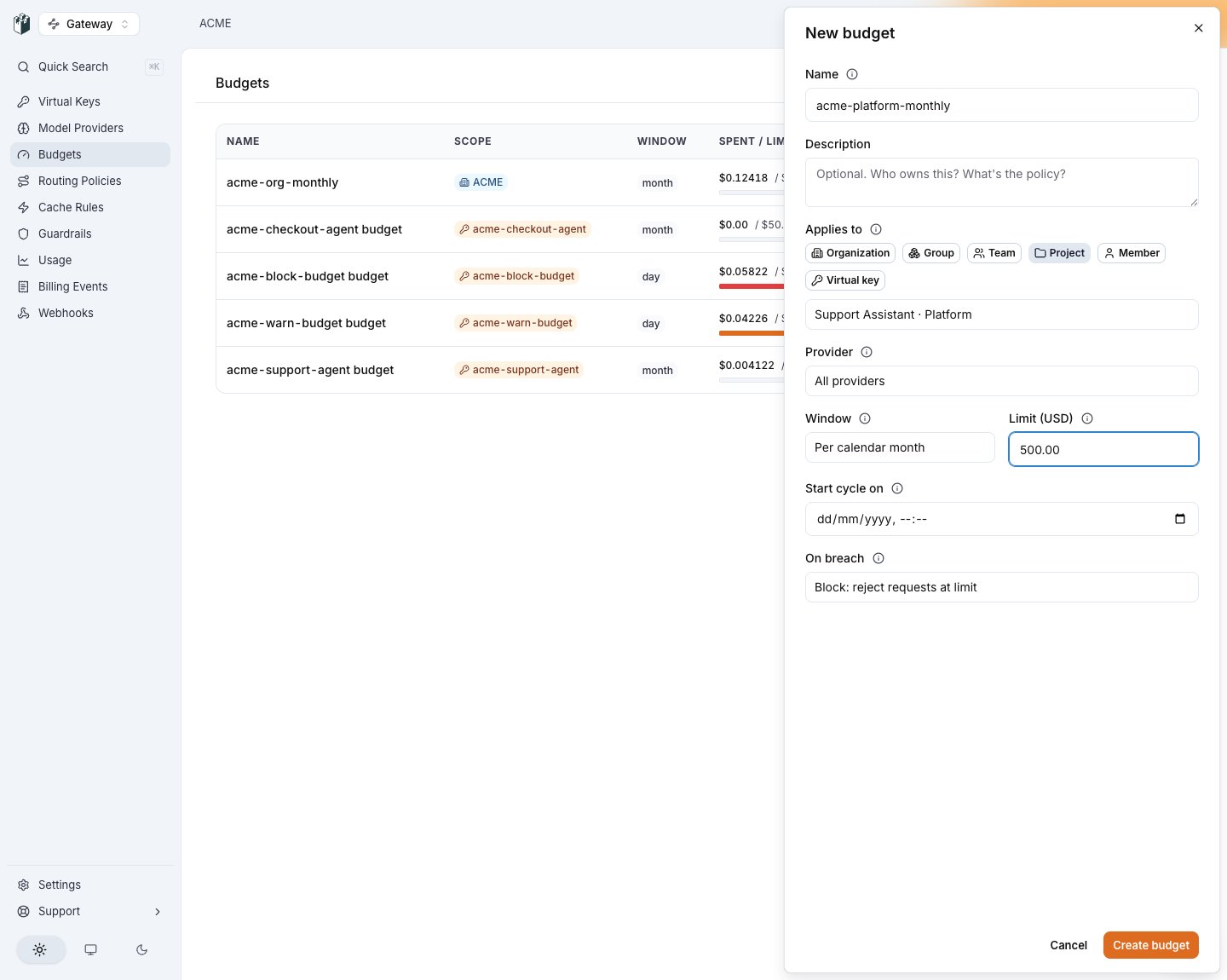
AI Gateway → Budgets → New budget.
FieldExample
Nameeng-team-monthly
Scopeteam
Targetplatform team
Windowmonth
Limit (USD)5000
on_breachwarn at 80%, block at 100% (see “Multiple tiers” below)
Save. The budget is in force immediately; the next request counts against it.

Multiple tiers on the same scope

A single scope can carry multiple budgets with different on_breach values. Common pattern:
  • Budget A: team, month, $4000, warn. Surfaces X-LangWatch-Budget-Warning: team:80 once 80% of the real ceiling is spent.
  • Budget B: team, month, $5000, block. Hard-caps at $5k.
The UI surfaces this as “Warning thresholds” on a single budget row; each threshold is stored as its own GatewayBudget row in the schema for simplicity.

Debit model

Gateway operations are debited after the response completes, using the provider-reported token counts. Every debit carries a gateway_request_id (ULID) and is idempotent by that id so gateway retries and trace replays never double-bill. Debit flow:
  1. Gateway streams the response to the client.
  2. When the response closes, the gateway captures the provider’s token counts and emits an OTel span carrying gen_ai.usage.* plus langwatch.virtual_key_id and langwatch.gateway_request_id.
  3. The gateway also posts a post-response debit event to the control plane for the primary ledger path.
  4. The control plane recomputes USD cost from tokens × pricing catalog (the gateway-side cost is authoritative only when it short-circuits without a provider call, e.g. blocked_by_guardrail) and writes a ledger row in a transaction that also increments spent_usd on every affected scope (org, team, project, VK, principal).
  5. In parallel, the trace-processing pipeline reads the same span, resolves the applicable budgets, and writes one row per budget to the ClickHouse ledger (gateway_budget_ledger_events, rolled up into gateway_budget_scope_totals by a materialised view). This CH path is idempotent by (tenant, budget, gateway_request_id) on the underlying ReplacingMergeTree.
The ClickHouse path is the primary read when CH is enabled (SaaS and any self-host with the LangWatch CH cluster wired up); the Postgres spentUsd column remains as the read fallback for self-hosted installs without CH. Both write paths run in parallel today; the Postgres write path retires in a follow-up. Customer-visible behaviour is unchanged — a 1budgetstillblocksat1 budget still blocks at 1 of spend during and after the cutover.

Pre-request check

Before dispatching to the provider, the gateway runs a two-tier precheck designed to keep the hot path free while avoiding stale-snapshot races as budgets approach their caps:

Tier 1 — cached snapshot (always)

The gateway checks the VK’s in-memory budget snapshot (refreshed via the /changes long-poll on every debit). If the snapshot already shows a hard-breach, the request is rejected immediately with 402 budget_exceeded — saving the provider spend and the wall-clock round-trip entirely. This costs ~0 μs: it’s an in-process map lookup.

Tier 2 — live reconciliation (near-limit only)

If any scope applicable to the request has spent_usd / limit_usd >= 0.90, the gateway makes a signed POST /api/internal/gateway/budget/check call to the control plane with ONLY those hot scopes. The control plane returns the real-time spent_usd from the authoritative ledger, and the gateway re-evaluates. Timeout is 200 ms; if the call fails, tier 1’s decision is used (fail-open). This closes the stale-snapshot race where two gateway nodes each see a cached spent=$24.90 / limit=$25.00 and both admit a 0.50requestproducing0.50 request — producing 25.80 in actual spend against a $25 cap. With tier 2 active on the near-limit 10% band, the control plane sees both requests and rejects the second based on the live ledger. Cold scopes (under 90%) skip the live call entirely — no latency tax on the common case.
request → tier 1 (always, ~0μs) → pass?
                                → breach? → 402 (saved provider spend)

tier 1 pass, any scope ≥ 90%? → tier 2 (live, ~5-50ms via HMAC-signed POST)
                              → live spent says breach? → 402
                              → live says OK? → dispatch
                              → timeout / 5xx? → dispatch (fail-open)
Gateway env knobs:
  • LW_GATEWAY_BUDGET_LIVE_THRESHOLD — default 0.9 (90%). Lower it for stricter enforcement at some latency cost.
  • LW_GATEWAY_BUDGET_LIVE_TIMEOUT — Go duration string, default 200ms. Accepts 200ms, 500ms, 1s, etc.

What “USD cost” means

Token × unit-price lookup, computed per provider using their published pricing. Updates land as provider pricing changes (pricing table is a separate Prisma table owned by LangWatch). Cache reads / writes are priced separately per provider — Anthropic cache reads are ~10% of regular input tokens, Anthropic cache writes are 125%. The gateway respects these. See Caching Passthrough.

Viewing budget spend (UI)

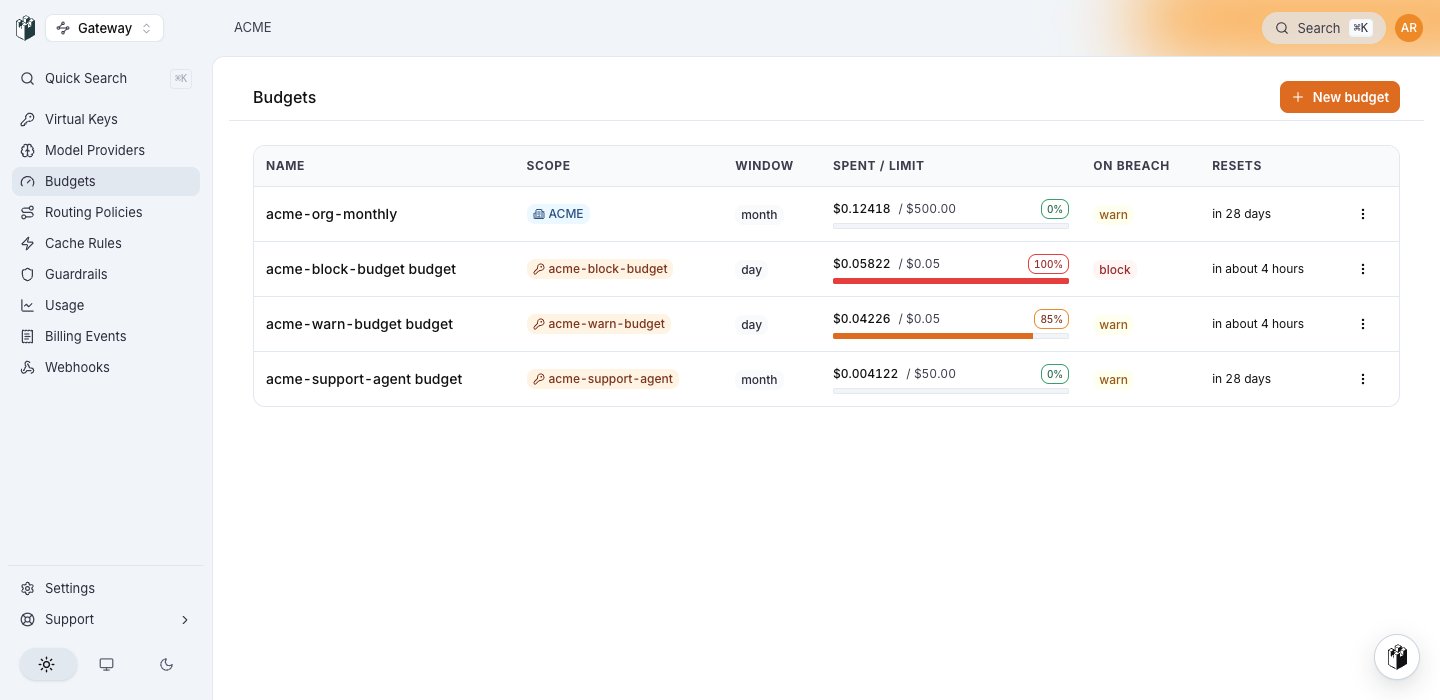
The /gateway/budgets list shows every budget with a utilization bar, hard cap, and remaining amount:
  • Spent/Limit column carries a colored progress bar and a matching %-badge (green ≤ 50%, orange 50-80%, red ≥ 80%/100%) so scanning “which budgets are hot” is a one-glance read.
  • Window column wraps hour / day / week / month / total in a subtle gray identifier badge matching the rest of the product.
  • Resets column shows a humanised relative time (“in 3 days” / “in 11 hours” / “in 15 minutes”) with a hover tooltip for the exact UTC timestamp. total-window budgets render a muted never.
  • Scope column resolves the raw scope id into the target’s human name and link: organization acme-demo, team platform, virtual_key prod-openai (linking to the VK detail page), principal user@example.com. Resolution is batched per scope type so the column adds no per-row DB cost.
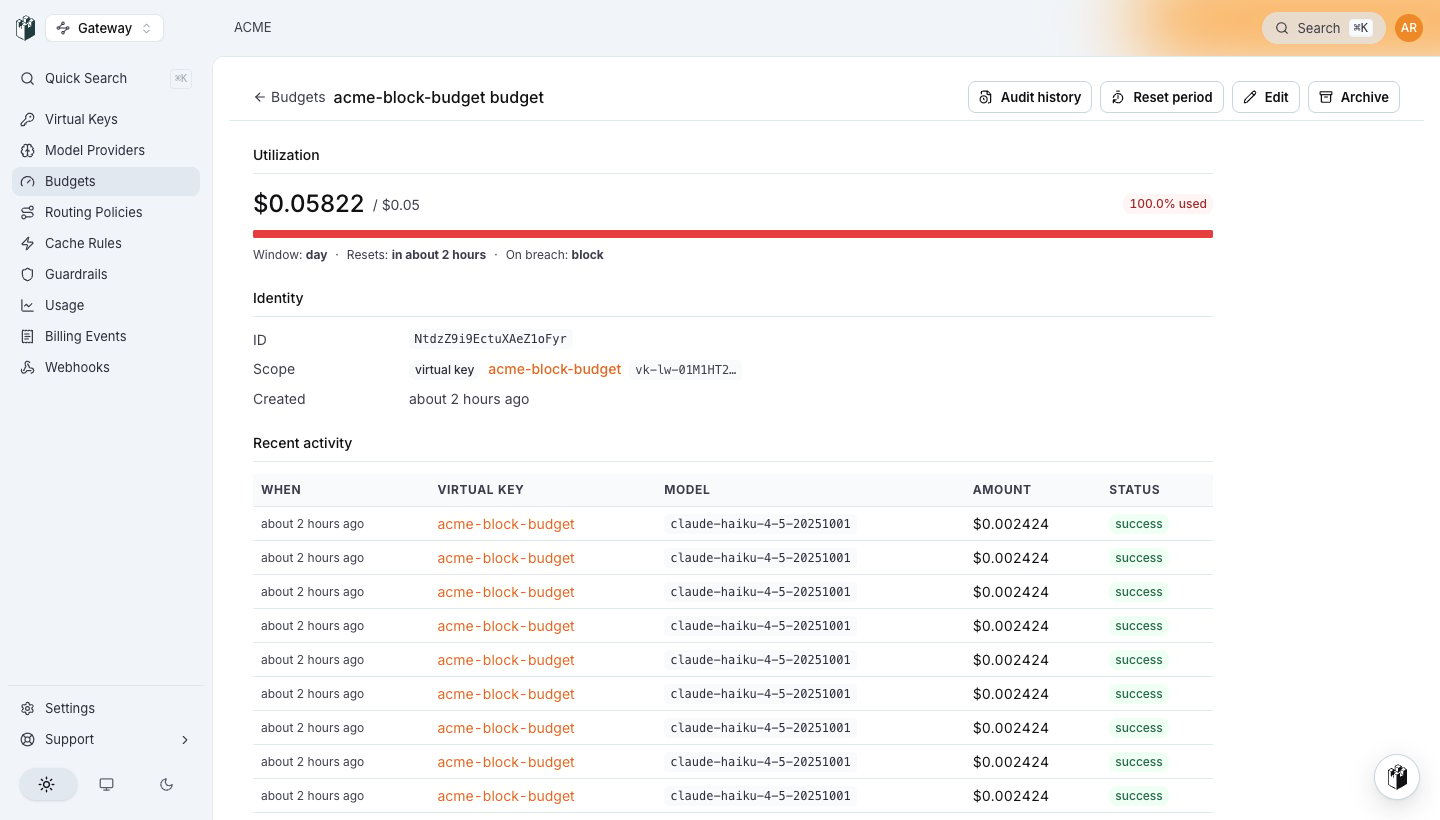
Clicking a row opens /gateway/budgets/[id] — a detail page mirroring the VK detail layout:
  • Header action bar: Audit history (deep-links to /settings/audit-log?targetKind=budget&targetId=<budget_id> pre-filtered to this budget’s events; stays visible on archived budgets so forensic investigations can start from the archived state), Edit, Archive.
  • Utilization header: hard cap, spent, remaining, on_breach mode.
  • Identity: name, description, window, timezone, created/updated timestamps.
  • Resolved scope target: same resolution as the list Scope column, plus a full-width link card to the target resource.
  • Recent 20 debits: each row shows When (humanised relative + hover-for-exact), Amount (smart-decimals — e.g. $0.0183, not $0.02), Model, originating VK (deep-linked to the VK detail page), and the gateway_request_id for trace search.
Paired with /gateway/usage, which shows a byDay sparkline between the stat tiles and “Top virtual keys”. The sparkline is gated on ≥ 2 data buckets so the 24-hour preset doesn’t render a single-point chart. Top-VK rows link to each VK’s detail page for drill-down. Programmatic equivalent:
# List budgets
langwatch gateway-budgets list

# Spend detail (same data the UI detail page renders)
curl -sS https://app.langwatch.ai/api/gateway/v1/budgets/<id> \
  -H "Authorization: Bearer $LANGWATCH_API_KEY"
The REST response includes the resolved scope-target fields the UI uses; the gatewayBudgets.get tRPC procedure powers both surfaces from a shared service method.

Permissions

ActionPermission
View budgetsgatewayBudgets:view
CreategatewayBudgets:create
EditgatewayBudgets:update
DeletegatewayBudgets:delete
All of the abovegatewayBudgets:manage
See RBAC.

Trace attributes

  • langwatch.cost_usd — cost of this single request.
  • langwatch.budget.breached_scope — present when the request was blocked; format scope:window (e.g. project:month).
  • langwatch.budget.warnings — comma-separated list of scope:pct_used entries for soft breaches.