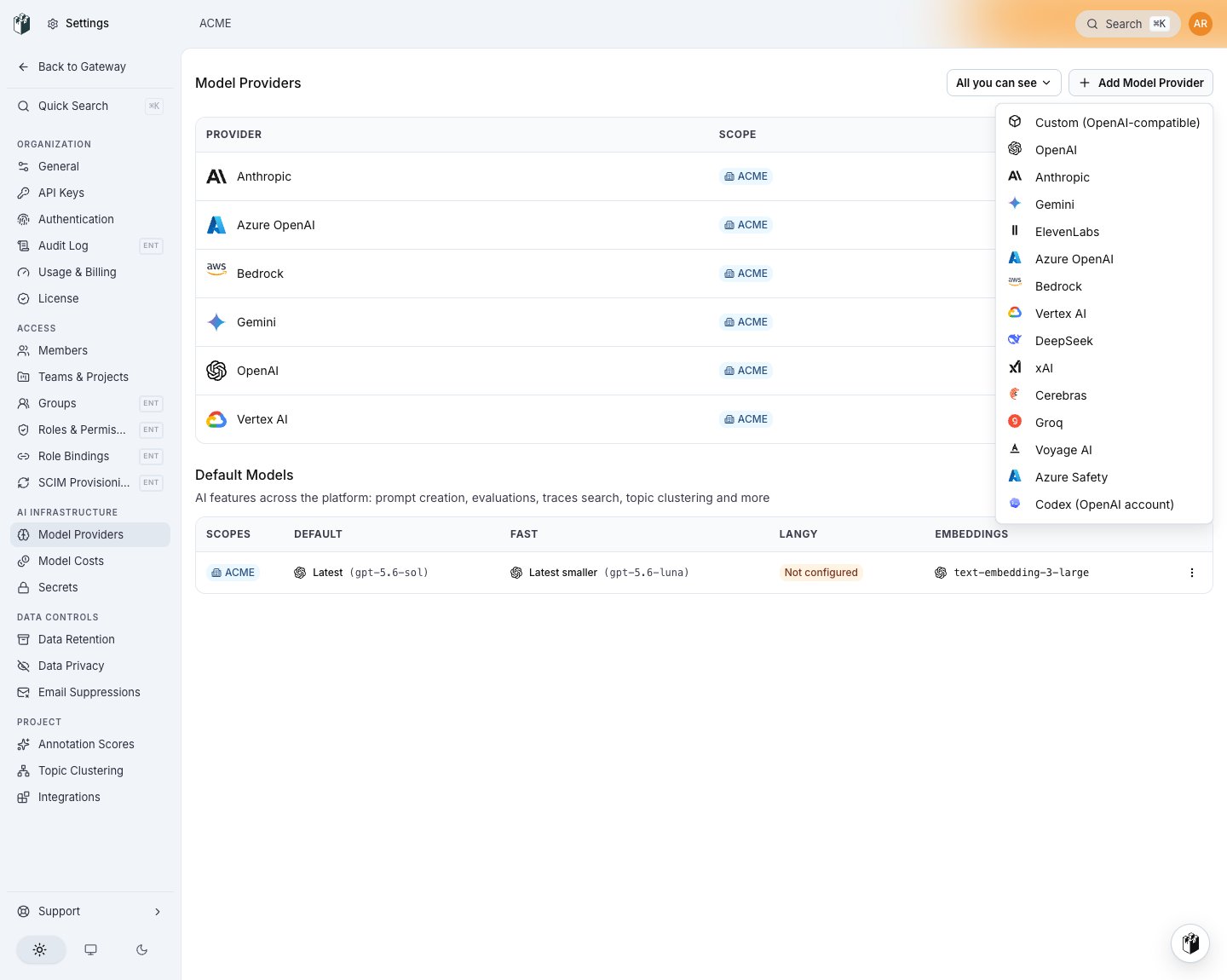
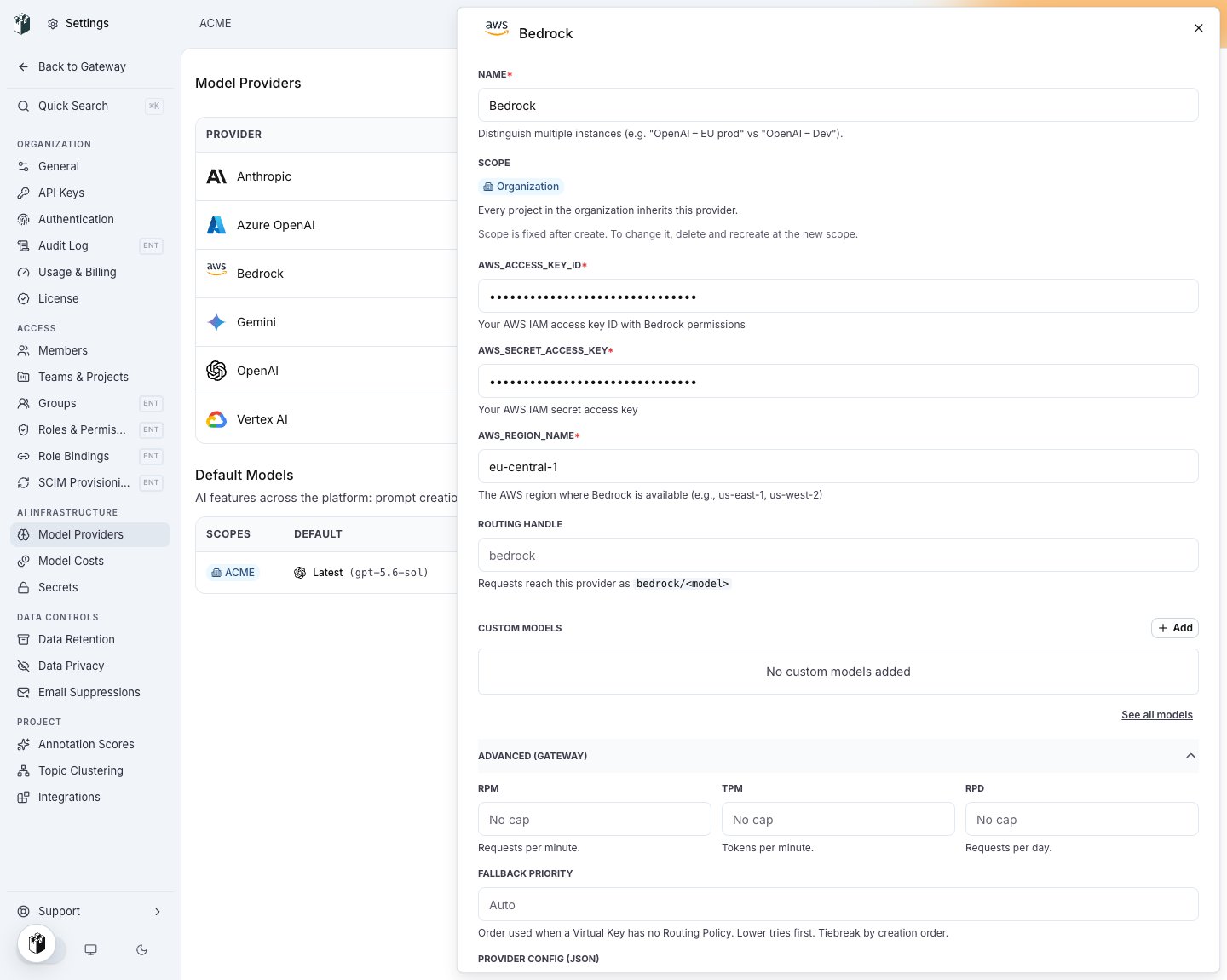
A provider binding is a gateway-specific wrapper around a model provider you’ve already configured in Settings → Model Providers. The LangWatch dashboard already knows how to talk to OpenAI / Anthropic / Gemini / Azure / Bedrock / Vertex — the gateway binding layers gateway-only settings on top of that existing credential:Documentation Index
Fetch the complete documentation index at: https://langwatch.ai/docs/llms.txt
Use this file to discover all available pages before exploring further.
- Which slot the binding fills in VK fallback chains
- Per-binding rate limits (RPM / RPD) applied before provider dispatch
- Fallback priority for selecting this binding when a VK has multiple bindings eligible
- (Future) Rotation policy for credential lifecycle
Binding a provider to the gateway
- Open /gateway/providers → Bind provider.
- Select one of the enabled model providers you have access to. The dropdown shows providers from every scope you can reach: the current project, any team containing it, and the org above (see Scope & access below). Providers not yet enabled appear in Settings → Model Providers — enable them there first.
- Fill in the gateway-specific fields below.
- Click Bind provider. The binding shows up in the VK “Provider fallback chain” drawer for every VK in the project.
Scope & access
Model providers live at one of three scopes — org / team / project — mirroring the RBAC principal-scope pattern. A provider binding in a project can reference any model provider that scope-chain walks from the binding’s project up to the owning org.| Provider scope | Visible to bindings in… |
|---|---|
ORGANIZATION | every project in the org (via any team) |
TEAM | every project in that team |
PROJECT | that project only |
OpenAI (org: acme), OpenAI (project: acme-demo)).
Why this matters for multi-project teams: one central OpenAI credential at the organization scope means all downstream projects reuse a single API key + billing account + rotation policy, while still letting individual projects layer their own gateway-level rate limits and slot names via the binding.
Who can create at each scope — permission follows the standard LangWatch scope ladder:
| To create a provider at… | Need… |
|---|---|
| Project scope | modelProviders:manage on the project |
| Team scope | modelProviders:manage on the team |
| Organization scope | Organization admin |
Fields
Model provider
The underlying provider configured in Settings. One binding per provider per project. If a provider is already bound the dropdown omits it (re-edit via the row).Slot
Free-form label used by the VK fallback chain to refer to this binding. Examples:primary, fallback-1, high-volume-openai. Defaults to primary.
The slot is cosmetic — the gateway dispatches based on the VK fallback chain order, not the slot name. But slot names make the fallback chain human-readable (“primary → fallback-1 → fallback-2”) rather than showing opaque IDs.
Rotation policy
Tracks how the underlying credential rotates. v1 supportsMANUAL only — the operator rotates the credential in Settings → Model Providers and the gateway picks up the new value on the next /changes long-poll (≤ 30 s).
The Bind-provider drawer does not surface this field in v1 because a single-option dropdown is worse UX than no field. Every binding is therefore implicitly
MANUAL. The Edit drawer still exposes it for forward compat; only MANUAL is accepted. Automatic rotation (on schedule) + external-secret-store integration (HashiCorp Vault, AWS Secrets Manager, etc.) are tracked as v1.1 features and will restore the dropdown when implemented.Rate limit — RPM
Requests per minute that the gateway will dispatch through this binding before returning429 rate_limit_exceeded. Applied at the binding level; independent of any VK-level rate limit.
Use this to protect a single upstream account from an over-eager VK. The gateway token-bucket enforces with cross-dimension accounting so you can combine per-binding + per-VK limits without double-counting.
Leave blank to inherit the upstream provider’s limit (i.e., no gateway-side throttle).
See Rate limits for the full dimension model.
Rate limit — TPM
Tokens per minute. Same shape as RPM but counts token usage instead of request count.Rate limit — RPD
Requests per day. Rolling 24-hour window, resets at first request after the window ticks. Useful for capping long-tail daily spend. Only present on the Edit drawer because RPD doesn’t make sense for the initial bind (you usually set it after observing traffic).Fallback priority (global)
A tiebreaker used when multiple bindings are simultaneously eligible for a VK’s fallback chain. Lower number = higher priority. Leave blank to fall back to the VK’s explicit ordering (normal case). Use when you want a single binding to be the “always-first fallback” across every VK in the project, without editing each VK’s chain. Example:fallback-priority-global: 10 on a cheap secondary makes that binding the first fallback for every VK that doesn’t override.
After binding
The new binding shows up in:- /gateway/providers list (the page you’re on)
- VK fallback chain dropdown (add/remove/reorder in the VK drawer)
- /gateway/usage aggregation (filter by provider slot or provider name)
- Gateway traces as
langwatch.provider = <provider_name>(the slot name is carried on the budget-debit event and ingateway_provider_attempts_totallabels, but not emitted as a span attribute in v1)
Disabling a binding
Settings → Disable (soft disable, via the row menu):- Existing VKs that reference this binding continue to resolve — the binding remains valid on the hot path for VKs that haven’t been edited.
- New VKs cannot select this binding in the create drawer.
- Existing bindings can be re-edited to change slot / rate limits without undoing the disable.
Permissions
| Action | Permission |
|---|---|
| View bindings | gatewayProviders:view |
| Bind a new provider | gatewayProviders:manage |
| Edit an existing binding | gatewayProviders:update |
| Disable / archive | gatewayProviders:manage |
See also
- Virtual keys — configure fallback chains referencing these bindings.
- Rate limits — RPM / RPD / (v1.1) TPM dimensions explained.
- Concepts → Fallback chain — why and when the gateway switches providers.
- Self-hosting → KMS — how provider credentials are protected at rest.