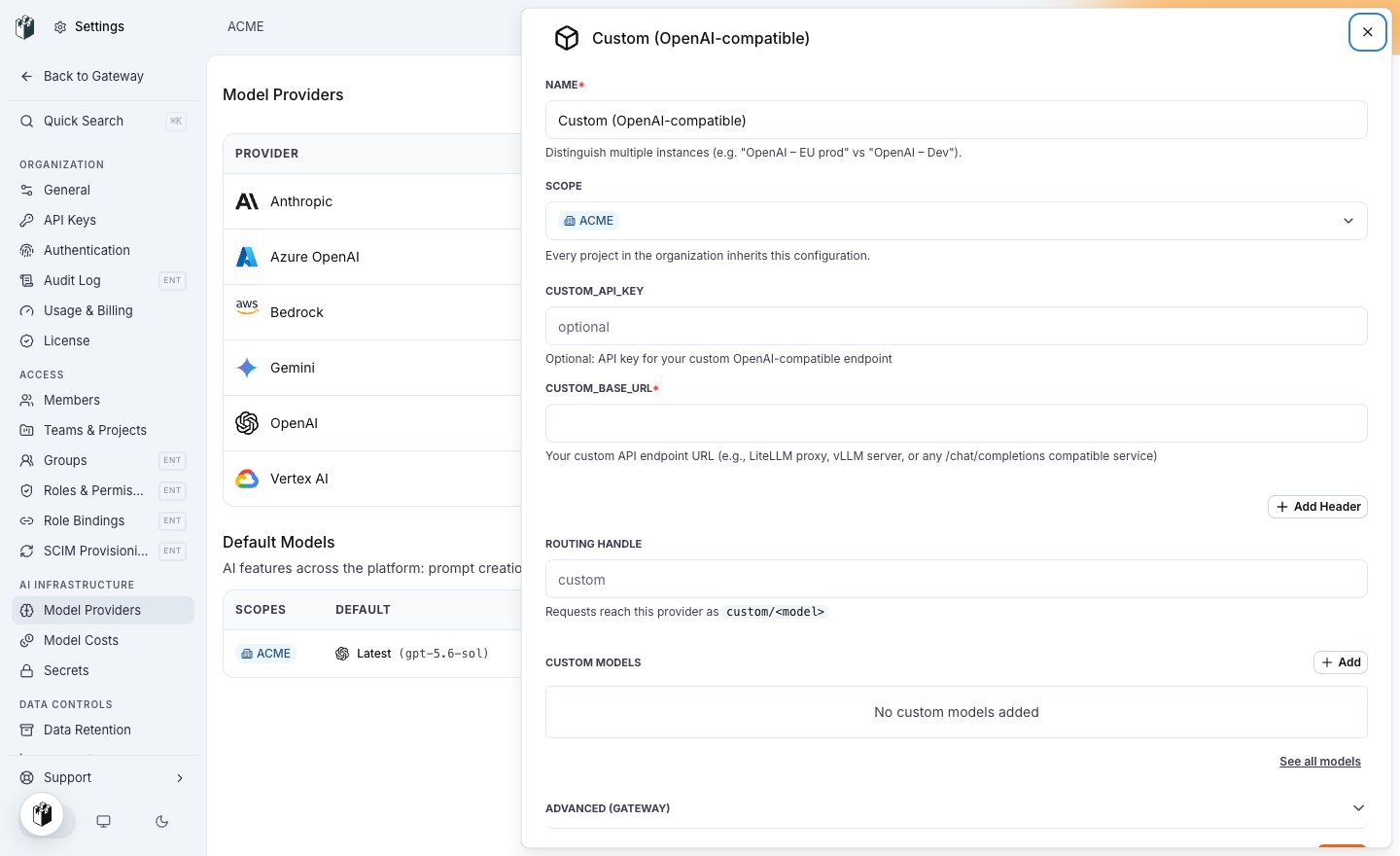
The Custom OpenAI-compatible provider accepts any HTTP endpoint that implements the OpenAI Chat Completions shape — covering self-hosted servers (vLLM, SGLang, Ollama, LocalAI, TGI), hosted inference platforms (Groq, Together, Fireworks, Anyscale), and private fine-tunes exposed via an OpenAI-shape proxy.Documentation Index
Fetch the complete documentation index at: https://langwatch.ai/docs/llms.txt
Use this file to discover all available pages before exploring further.
Configure the provider credential
Under Settings → Model Providers:- Add provider → Custom (OpenAI-compatible).
- Fill:
- Name — human label (e.g.
internal-vllm,groq). - Base URL — without the
/chat/completionssuffix (e.g.https://api.groq.com/openai/v1,http://vllm.internal:8000/v1). - Auth mode —
Bearer(default),api-keyheader, orcustom header(for non-standard keys). - API key — or leave blank for unauthenticated self-hosted endpoints.
- Supported models — optional allowlist to expose a curated subset via
/v1/models.
- Name — human label (e.g.
- Save.
Supported endpoints (varies by upstream)
The gateway forwards requests 1:1 to the upstream path (/v1/chat/completions, /v1/embeddings). If the upstream doesn’t implement a path, the gateway returns the upstream’s 404 or 405.
Common subsets:
- Groq / Together / Fireworks — chat + embeddings (most models).
- vLLM / SGLang — chat + embeddings (depends on the model).
- Ollama — chat (via the OpenAI-compat endpoint mode).
Model id format
Pass the upstream-native model id directly. Aliases still work:/ is the ModelProvider’s Name (e.g. custom-groq); everything after is the upstream model id.
Caching
Gateway defaultcache.mode = respect forwards any cache-control headers or body fields the upstream understands. Most OpenAI-compatible servers don’t expose a standardised prompt-caching API, so X-LangWatch-Cache: hit will generally read as miss unless the upstream implements one.
Known quirks
- Streaming format drift. Some OpenAI-compatible servers diverge on SSE chunk format (extra newlines, differing
[DONE]casing, missingdata:prefix on metadata frames). Test streaming early; bifrost/core normalises what it can but edge cases may require a client retry. - Auth header unconventional. Ollama historically uses no auth; vLLM uses Bearer; some self-hosted deployments use
X-Api-Key. Pick the right mode at ModelProvider config time. /v1/embeddingsresponse shape — OpenAI-spec says each embedding is a list of floats. Some providers emit a single flat float array. Bifrost/core coerces to spec shape.- Model allowlist enforcement. If the upstream serves 100 models and you only want 3 exposed, set
models_allowedon the VK rather than the ModelProvider — it’s per-VK, so different VKs can curate different subsets.
Use cases
- Private fine-tunes. Your ML team deploys a vLLM serving a fine-tuned model on internal infra. The gateway makes it accessible to every engineer’s coding CLI with a VK, governed like any other model.
- Hosted inference platforms. Groq / Together / Fireworks / DeepInfra ship OpenAI-compat APIs at competitive prices. Binding them behind the gateway lets you A/B against OpenAI without application changes.
- Local dev. An engineer on the road can point the gateway at a local
ollamaserver to work offline while preserving the same VK-based auth contract.