Documentation Index

Fetch the complete documentation index at: https://langwatch.ai/docs/llms.txt

Use this file to discover all available pages before exploring further.

The gateway enforces rate limits at two independent layers — the VK and the provider binding — with cross-dimension token-bucket accounting so a request only needs enough tokens in every applicable bucket to pass.

Dimensions

RPM — requests per minute

Classic Leaky-bucket / token-bucket: a counter that refills at limit / 60 tokens per second, caps at limit. Every request consumes 1 token. Bucket empty → the request returns 429 rate_limit_exceeded with Retry-After seconds to refill. Good for: protecting providers from a flood, enforcing a fair-share per customer, giving CI pipelines a known cap. Not for: cost enforcement — use budgets for spend caps.

RPD — requests per day

Rolling-24-hour window. Every request consumes 1; counter resets at the first request after the window ticks. RPD and RPM are enforced jointly — a request that fits under RPM still fails if RPD is exhausted. Good for: capping long-tail daily spend (cheaper than budgets for simple per-user limits), rate-limiting evaluation runs to stay under a provider’s daily quota.

TPM — tokens per minute (v1.1)

TPM is a v1.1 feature. In v1 the limit is accepted and stored on VK + binding config but not enforced — requests pass through and the trace + budget ledger still record the real token count. Implementation blocker: the streaming-usage accumulator needs to be wired into the limiter before per-stream token counts can pressure the bucket.
When v1.1 ships, TPM will consume tokens based on actual usage reported by the provider (or estimated on request body for pre-dispatch shaping). The accounting will be cross-dimension with RPM + RPD, so a request fits if every applicable bucket has room.

Precedence

The gateway evaluates limits in the order it touches them:
  1. Per-binding (configured on /gateway/providers) — protects a single upstream account from all traffic.
  2. Per-VK (configured on /gateway/virtual-keys drawer) — protects a specific key from over-sending.
A request must fit under every applicable bucket. No override mechanism — combining them is always AND.

429 envelope

When the bucket rejects, the response is:
HTTP/1.1 429 Too Many Requests
Retry-After: 4
X-LangWatch-RateLimit-Dimension: rpm
Content-Type: application/json

{
  "error": {
    "type": "rate_limit_exceeded",
    "code": "rate_limit_exceeded",
    "message": "Rate limit exceeded on dimension=rpm"
  }
}
X-LangWatch-RateLimit-Dimension identifies which bucket tripped:
  • rpm — minute bucket full
  • rpd — daily bucket full (only when both RPM and RPD are configured and RPD tripped first)
  • tpm — v1.1 only
The client key-switches on this header to show the right error in their own UI (e.g., “daily quota reached, reset at midnight UTC” vs “slow down, try again in a minute”).

Setting limits

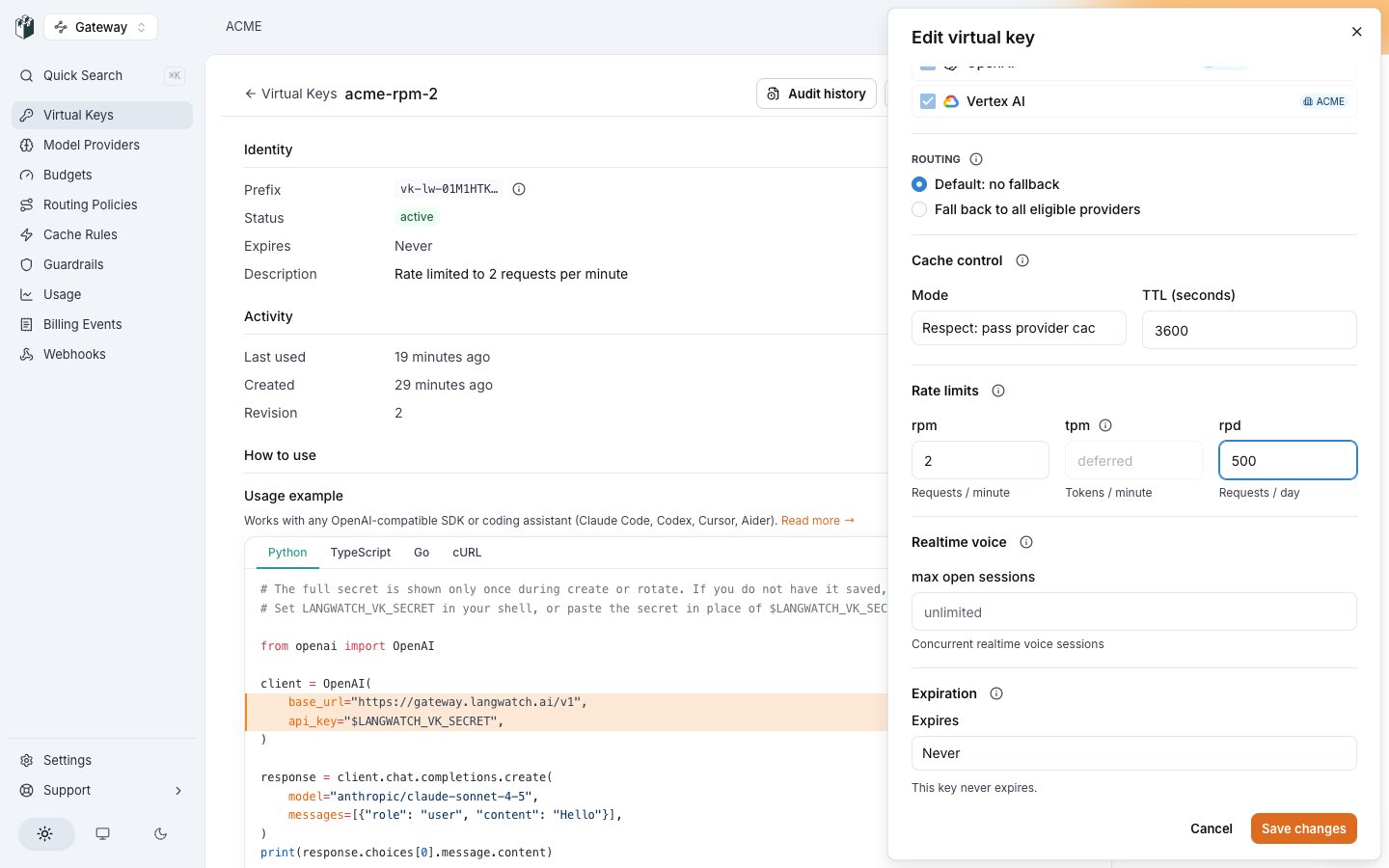
Per VK/gateway/virtual-keys drawer → “Rate limits (per-VK)” section. See the drawer’s (i) tooltips for per-field guidance. Per binding/gateway/providers drawer → “Rate limit (rpm)” / “Rate limit (rpd)” / “Rate limit (tpm)” fields. See Provider bindings → RPM. Leave a field blank to inherit the upstream provider’s own limit (i.e., no gateway-side throttle on that dimension).

Observability

Rate-limit events surface via the gateway’s standard observability primitives — there is no dedicated rate-limit counter in v1:
  • HTTP metric gateway_http_requests_total{status="429"} — counts 429s including both gateway-enforced and upstream-reported.
  • Upstream attempt metric gateway_provider_attempts_total{outcome="rate_limit"} — increments when a 429 came back from the provider (not from gateway-side enforcement). Joining on status="429" vs outcome="rate_limit" distinguishes gateway-enforced (status 429, no provider_attempts increment on that dimension) from upstream-enforced.
  • Response header X-LangWatch-RateLimit-Dimension — the downstream key-switch signal (also included in the span error message for trace-level analysis).
  • Trace error — the rejected request’s span carries error.type="rate_limit_exceeded" with the dimension in the message string.
A dedicated gateway_rate_limit_rejects_total{dimension} counter that slices by dimension without needing to parse the trace stream is a v1.1 observability follow-up. Until then, dashboards can filter gateway_http_requests_total{status="429"} by the Retry-After header or check the X-LangWatch-RateLimit-Dimension value in trace attributes at query time.

Cross-replica coordination

In multi-replica deployments the buckets are per-replica by default — the gateway’s limiter is an in-memory golang.org/x/time/rate token bucket stored in an LRU cache, zero external dependency on the hot path. If your cluster runs N replicas, the effective org-wide RPM is N × configured_rpm (explicit design trade: zero-dependency on the hot path over strict cluster-wide correctness).
Redis-coordinated counters for strict cross-replica enforcement are a v1.1 follow-up (tracked in services/gateway/internal/ratelimit/limiter.go package doc). Deployments that need exact org-wide caps today can set the per-replica limit to configured / N and rely on the LB’s round-robin to keep pods equally loaded — imperfect but usually fine.

Permissions

ActionPermission
View rate-limit settingsvirtualKeys:view + gatewayProviders:view
Edit per-VK rate limitsvirtualKeys:update
Edit per-binding rate limitsgatewayProviders:update

See also