Documentation Index

Fetch the complete documentation index at: https://langwatch.ai/docs/llms.txt

Use this file to discover all available pages before exploring further.

Azure OpenAI is enterprise OpenAI with data-residency, AAD integration, and SLA guarantees — but with a deployment-based model-id convention that breaks most OpenAI SDKs out of the box. The gateway handles Azure’s quirks via bifrost/core so any OpenAI-shaped client just works.

Configure the provider credential

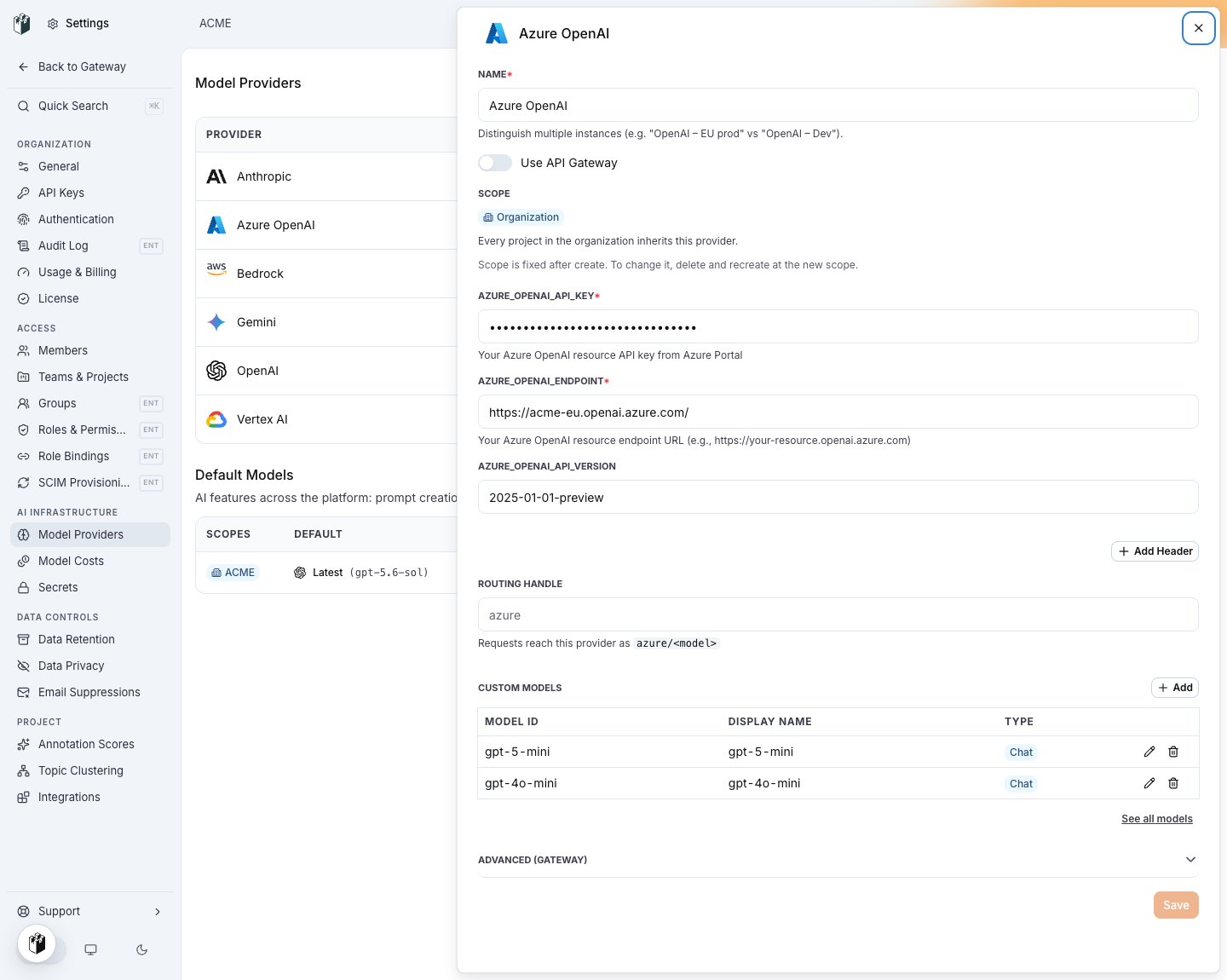
Under Settings → Model Providers:
  1. Add provider → Azure OpenAI.
  2. Paste:
    • Endpoint — e.g. https://my-resource.openai.azure.com.
    • API key — Azure OpenAI key (hex string).
    • API version — e.g. 2024-08-01-preview (pin explicitly; don’t rely on “latest”).
  3. (Optional) Default deployment name — if clients send a bare model name, the gateway maps it to this deployment.
  4. Save.

Deployment-based model routing

Azure OpenAI binds models to deployments, which have customer-chosen names. gpt-4o in the OpenAI SDK needs to become my-gpt-4o-deployment at Azure — a mapping step. The gateway handles this via VK model_aliases:
{
  "model_aliases": {
    "gpt-4o":       "azure/my-gpt-4o-deployment",
    "gpt-5-mini":   "azure/my-mini-deployment",
    "o3":           "azure/my-o3-deployment"
  }
}
Now an OpenAI-SDK client that sends model: "gpt-4o" reaches the correct Azure deployment without knowing Azure exists. This is a key value-prop of aliases — the VK owner maps generic model names to their Azure infrastructure, and application code never changes.

Supported endpoints

Identical to OpenAI direct:
  • /v1/chat/completions, /v1/responses, /v1/embeddings, /v1/images/generations, /v1/audio/*, /v1/moderations.
The gateway translates the outgoing path + query string to Azure’s format (/openai/deployments/{deployment}/chat/completions?api-version=...).

Auth headers

OpenAI uses Authorization: Bearer, Azure uses api-key: <hex>. Bifrost/core swaps headers automatically based on the ModelProvider type. The client-facing VK auth is always Authorization: Bearer lw_vk_live_… (or one of the alternates — see Virtual Keys).

AAD / Managed Identity

For self-hosted gateway in Azure (AKS, App Service), you can omit the API key and use AAD auth:
  1. Assign the gateway’s managed identity the “Cognitive Services OpenAI User” role on the Azure OpenAI resource.
  2. Set the ModelProvider’s API key to __use_aad__ (sentinel).
  3. The gateway uses DefaultAzureCredential to fetch tokens.
Token caching + refresh are handled by bifrost/core.

Known quirks

  • API version drift. Azure changes API versions frequently; 2024-02-01 and 2024-08-01-preview have different request/response shapes. Pin the version on the ModelProvider; don’t rely on the newest.
  • Content filtering. Azure runs its own content filter before and after the model. A request blocked by Azure’s filter returns 400 with a content_filter_result body; the gateway surfaces this as provider_error with the filter metadata in the OTel trace.
  • Streaming SSE format. Identical to OpenAI direct — data: {...}\n\n frames terminated by data: [DONE]. Byte-for-byte passthrough applies.
  • Region naming. Azure regions use dash-case (eastus, westeurope) vs AWS’s dot-case. The gateway does not enforce a region — it’s baked into the Endpoint URL.
  • Rate limits. Azure has per-deployment quota (PTU or TPM-based). A 429 shows Retry-After like OpenAI; treat it the same way (fallback trigger or client retry).
  • Unsupported features. Some OpenAI features (e.g. /v1/audio/speech TTS) are not yet available on Azure OpenAI depending on region.

Bifrost/core handles the ceremony

The key-selling-point of the bifrost/core library: it hides the Azure idiosyncrasies (deployment URL construction, api-key vs Bearer, API-version query param, AAD vs key auth, regional endpoint detection). Users of the gateway see a plain OpenAI-shape API.